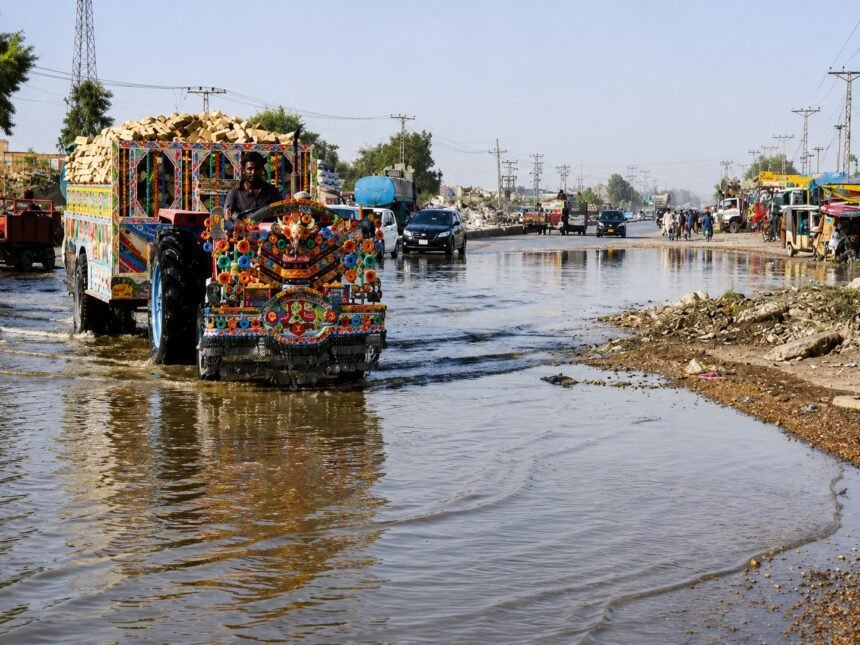
Sindh’s business community has questioned the use of more than Rs1.5 trillion collected through infrastructure cess over the past five years, saying industrial areas in the province still suffer from broken roads, poor drainage, weak water supply and missing treatment facilities.
The criticism was raised by Adeel Siddiqui, a member of the FPCCI Executive Committee, who said the levy was meant to support infrastructure development and maintenance, yet many industrial estates continue to operate in poor conditions. His remarks have renewed debate over where the money went and why basic industrial infrastructure has not improved despite years of collections.
The levy in question is the Sindh Infrastructure Cess, charged on imported goods entering the province by sea or air. According to the Sindh Excise Department, the cess has been applied at 1.80% to 1.85% of the assessed customs value, depending on the weight of the consignment. For importers, that is not a small charge. Over time, it has become a major source of provincial revenue.
But industry representatives argue that the benefit has not been visible on the ground. Siddiqui specifically pointed to Hyderabad and Kotri industrial estates, where manufacturers continue to complain about damaged roads, unreliable water supply, poor sewerage and inadequate waste-treatment systems.
The condition of Hyderabad SITE is especially symbolic. Established in 1952 over 1,264 acres, the estate has around 665 industrial units, with roughly 450 functional units. Despite being one of Sindh’s oldest industrial zones, business leaders say it still lacks the level of infrastructure needed for modern manufacturing.
The complaint is simple, and frankly hard to ignore: if the province has collected such a large amount in the name of infrastructure, why are industrial roads still in bad shape?
Siddiqui has called on the Sindh government to make public the details of how infrastructure cess funds were used. Industry groups say transparency is essential because the cess directly affects import costs and, ultimately, production costs. When businesses pay a levy linked to infrastructure, they expect roads, drainage, water lines and treatment plants to improve — not remain stuck in the same condition year after year.
The issue also comes at a sensitive time for Sindh’s industrial sector. Manufacturers are already dealing with high energy costs, taxation pressure, expensive financing and weak demand. Poor infrastructure adds another layer of cost, from vehicle damage and transport delays to production disruptions caused by water and drainage problems.
Earlier this year, Sindh amended its infrastructure cess law, reducing the levy to below 1% and abolishing it on exports. The provincial government argued that the earlier structure was not bringing meaningful benefit to the province. Still, the larger question remains unresolved: how were past collections used, and did industrial areas receive their fair share?
For now, the demand from industry is not just for better roads. It is for an audit, public disclosure and a clearer link between the money collected and the projects delivered. Without that, the infrastructure cess will keep looking less like a development tool and more like another cost placed on businesses already struggling to stay competitive.