Surrey: For nearly two centuries, a busy road cut across one of southern England’s most striking natural landscapes. Now, years after traffic was moved underground, the former route of the A3 at Hindhead has become a quiet corridor for wildlife, showing how removing a road can help nature stitch itself back together.
The story centres on Hindhead Commons and the Devil’s Punch Bowl in Surrey, a rare heathland and woodland landscape owned and managed by the National Trust. The Devil’s Punch Bowl is a large natural amphitheatre and a protected Site of Special Scientific Interest, known for its steep slopes, heathland, streams and woodland.
For decades, the old A3 road carried traffic between London and Portsmouth along the edge of the Devil’s Punch Bowl. It was noisy, congested and dangerous — and, from nature’s point of view, it split the habitat in two. Animals that might once have moved freely across the commons faced a hard barrier of fast-moving vehicles.
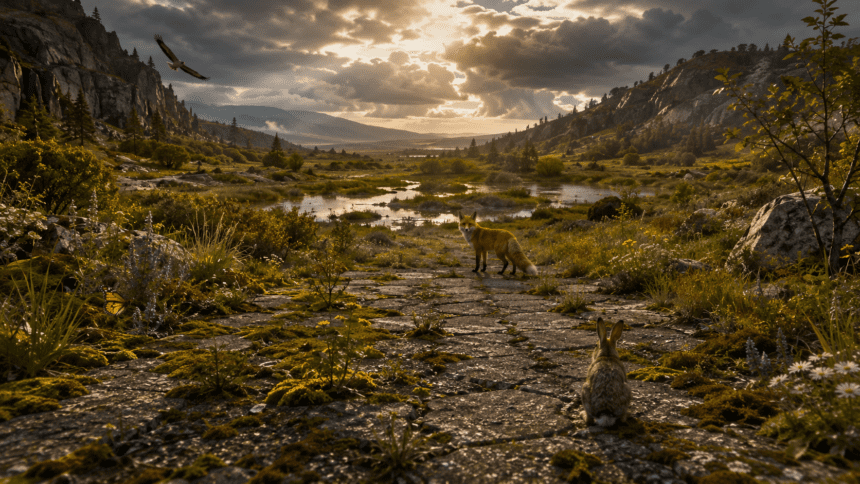
That changed after the Hindhead Tunnel opened in 2011. The tunnel took traffic beneath the landscape, allowing a section of the old road to be removed and returned to nature. The route that once carried cars and lorries was buried, replanted and gradually softened back into the surrounding heathland.
It was a rare reversal. Roads are usually built through wild places; here, one disappeared.
The restoration helped reconnect the Devil’s Punch Bowl with Hindhead Common, creating safer movement for wildlife and improving habitat for rare heathland species. The former road corridor is now part of a wider effort to restore fragile habitats for breeding birds and other wildlife while still allowing people to enjoy the landscape.
The project has been especially important for species linked to open heath and mixed woodland. Ground-nesting birds such as woodlarks and nightjars benefit when fragmented habitat is reconnected, while reptiles, insects and small mammals also gain from quieter, more continuous natural cover. The road’s removal reduced noise, pollution and the physical danger created by traffic.
The change is not only ecological. Visitors now experience the Devil’s Punch Bowl in a very different way. Where engines once dominated the soundscape, walkers hear wind, birds and the ordinary quiet of open land. The National Trust has also improved access, including an all-weather path along part of the old A3 route, making the restored landscape easier for walkers, wheelchair users and families with pushchairs to explore.
The Hindhead example has become a powerful case study in landscape repair. It shows that rewilding does not always mean abandoning land completely or bringing back large animals. Sometimes, it begins with removing a barrier — a road, a fence, a drainage channel — and giving nature room to move again.
There is still work to do. Heathland needs careful management, especially as climate pressure, invasive growth and visitor numbers increase. But the transformation at Hindhead offers something increasingly rare in conservation: visible recovery.
A road that once divided the land has almost vanished from view. In its place, a damaged landscape is slowly breathing again.