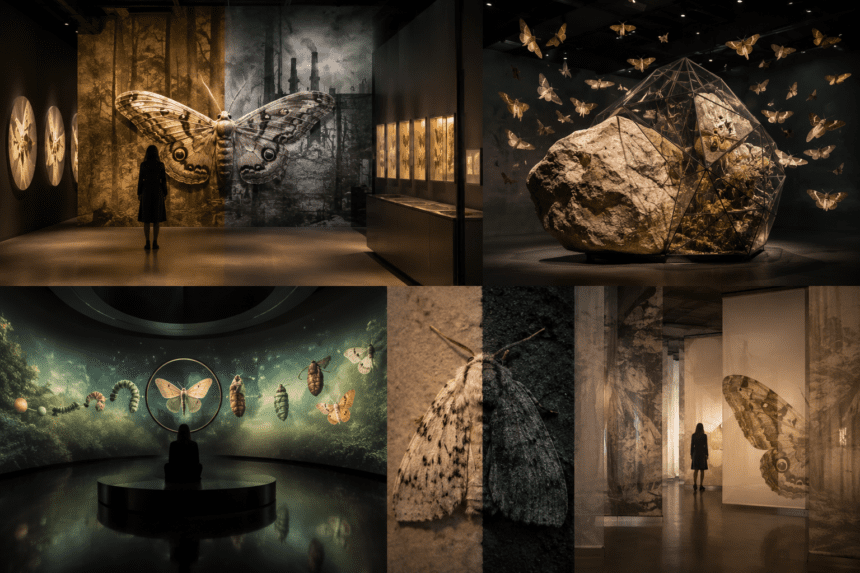
Moths are shedding their reputation as mere nighttime nuisances. A new exhibition opening this week at the Natural History Museum pulls back the curtain on these insects, showcasing how they have evolved to master some of the world’s most challenging environments.
The display centers on the “Evolutionary Toolbox,” a collection of specimens and high-resolution imaging that tracks how moths have shifted their biology to survive in total darkness. While many species rely on pheromones to navigate, researchers found that certain moths have developed acoustic defenses that actively jam the sonar signals of hunting bats. It isn’t just a passive survival tactic; it’s an active, evolutionary arms race happening in the dark.
“People often think of moths as the dull cousins of butterflies,” says Dr. Elena Vance, the lead curator behind the project. “But when you look at how they’ve adapted their sensory organs to detect shifts in air pressure and temperature, you realize they are some of the most sophisticated navigators on the planet.”
The exhibition highlights the “Peppered Moth” phenomenon, a classic case study in industrial melanism. The display illustrates how these insects changed their wing pigmentation in the 19th century to blend into soot-covered trees during the height of the Industrial Revolution. It’s a stark visual record of how rapidly an environment can force a species to rewrite its genetic playbook.
Data gathered from the latest field studies suggests these adaptations are currently being tested by climate change. As urban light pollution increases, many moth species are losing their ability to navigate by the moon. The exhibition displays real-time tracking data from three major metropolitan areas, showing how moths are increasingly drawn to artificial light sources—a behavior that is fundamentally disrupting their reproductive cycles.
The final gallery leaves the science behind and focuses on the ecological stakes. Moths are vital pollinators, often doing the heavy lifting for crops that bloom after sunset. If their ability to adapt to artificial light and chemical pesticides fails, the impact on global food security could be far more severe than current models predict.
The exhibition runs through the end of the year, offering a rare look at the insects that keep the world’s ecosystems running while we sleep. For those who still see them as pests, the message is clear: the moths are doing far more than just circling the porch light.