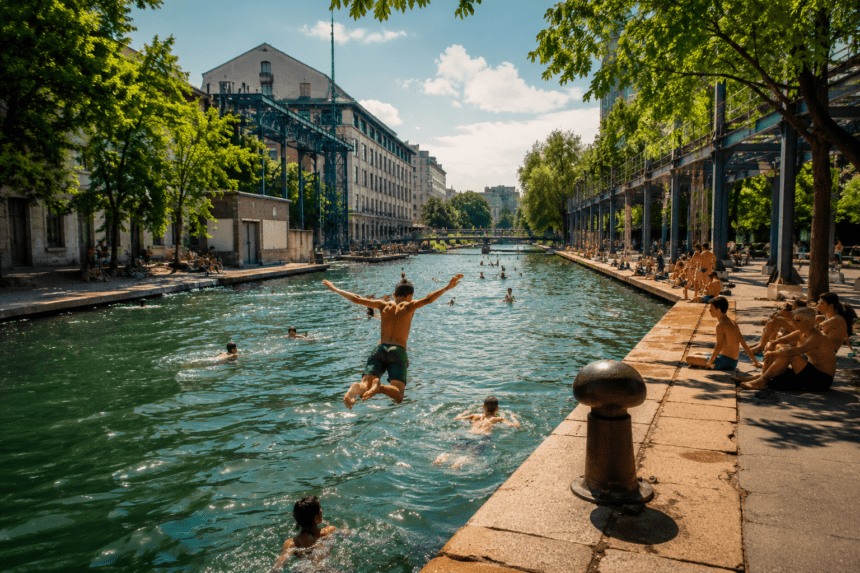
PARIS — As temperatures pushed past 33°C this week, the manicured fountains of the Tuileries Garden weren’t enough. Hundreds of Parisians bypassed the city’s official swimming zones, instead reclaiming the Canal de l’Ourcq—a gritty, industrial waterway in the city’s northeast—to escape the stifling heat.
The canal, once a hub for coal barges and freight, has become the city’s unofficial summer refuge. While city authorities officially discourage swimming in the murky, deep water due to safety risks and heavy boat traffic, the lure of a cool dip remains stronger than the warning signs.
For local residents, the canal offers something the city’s pristine pools don’t: a lack of red tape. No entrance fees, no booking apps, and no lines. “It’s not the Seine, and it’s certainly not the Mediterranean,” said Marc-Antoine, a 28-year-old resident of the 19th arrondissement, as he waded near the Bassin de la Villette. “But when the pavement is melting, you don’t look for a lifeguard. You look for water.”
City officials face a losing battle. The police occasionally patrol the banks, signaling swimmers to clear out, but the moment the flashing lights disappear, the splashing resumes. The tension between public safety and the desperate need for urban cooling is intensifying as heatwaves become a permanent fixture of the Parisian summer.
The canal’s water quality remains a point of contention. While the city has invested millions in cleaning up the Seine for Olympic-level swimming, the industrial canals of the north haven’t received the same level of sanitation infrastructure. Health experts warn that the water can harbor bacteria, yet the health risks seem a secondary concern to the immediate relief of the heat.
Paris is built for aesthetics, not thermal resilience. The city’s dense stone architecture and lack of green space trap heat, turning neighborhoods into ovens by late afternoon. As the city warms, the divide between those who can afford air-conditioned retreats and those who head to the canal will only widen.
For now, the canal serves as a makeshift commons. As the sun sets, the crowd thins, leaving behind empty plastic bottles and the lingering, humid scent of the water. Until the city provides a viable alternative for the working-class districts of the northeast, the industrial canal will remain the most popular—and dangerous—pool in Paris.