Scientists have uncovered new clues about Giganotosaurus, one of the largest meat-eating dinosaurs ever discovered. The latest fossil research is providing paleontologists with a deeper understanding of the giant predator’s anatomy, hunting behavior, growth, and role in the ecosystems of South America nearly 98 million years ago.
Researchers examined fossilized bones, skull fragments, and digital 3D reconstructions to better understand how Giganotosaurus lived and moved. The findings suggest that the dinosaur had a lightweight yet powerful skeleton, long muscular legs, and a massive skull equipped with sharp, serrated teeth designed to slice through the flesh of large prey.
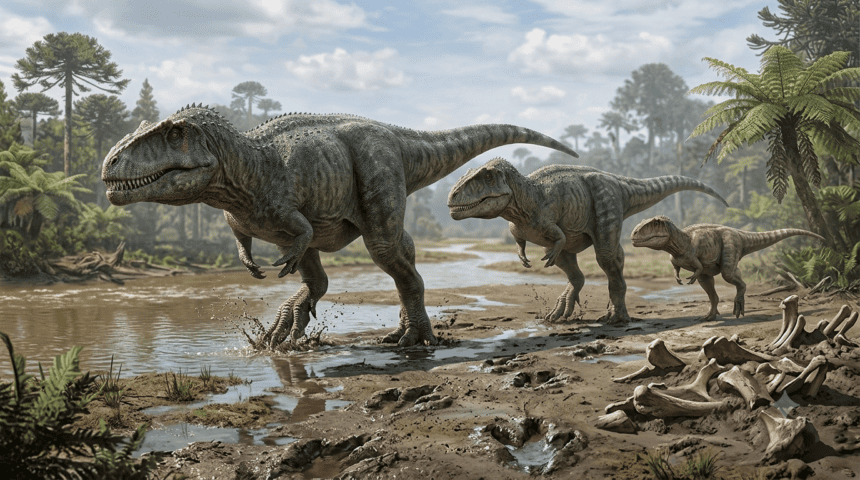
Scientists estimate that an adult Giganotosaurus measured approximately 12 to 13 meters (39–43 feet) in length and weighed up to 8 tonnes, making it one of the largest terrestrial predators known to science. Despite its enormous size, researchers believe it was a fast and agile hunter capable of pursuing large herbivorous dinosaurs across ancient floodplains.
Unlike Tyrannosaurus rex, Giganotosaurus had a longer and narrower skull with blade-like teeth that were better suited for delivering deep cutting bites rather than crushing bone. Scientists believe it likely preyed on enormous sauropod dinosaurs that inhabited prehistoric South America.
The study also suggests that Giganotosaurus may have possessed keen eyesight and a highly developed sense of smell, helping it locate prey over long distances. Some researchers continue to investigate whether it occasionally hunted in groups, although there is currently no definitive evidence supporting coordinated pack hunting.
Fossil discoveries have revealed that Giganotosaurus lived in a warm environment filled with rivers, forests, and diverse dinosaur species, providing a rich ecosystem capable of supporting one of Earth’s largest carnivorous dinosaurs.
Scientists emphasize that each new fossil discovery improves our understanding of dinosaur evolution and prehistoric ecosystems. Future excavations and advanced imaging technologies are expected to uncover even more about the biology and behavior of this remarkable predator.