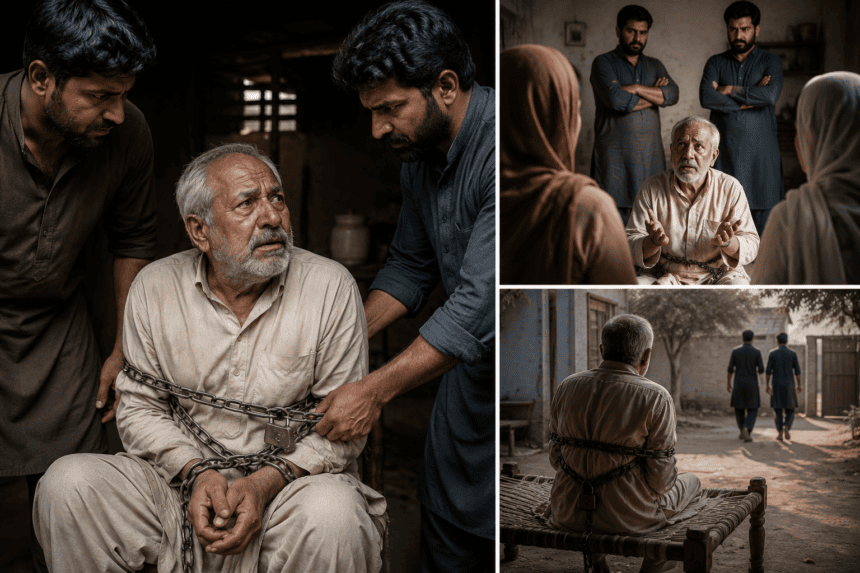
A 70-year-old man remains under police protection after his own sons allegedly chained him to a bed for days, punishing him for his decision to grant his daughters their legal share of the family property.
The incident, which took place in a rural district, surfaced when local authorities received a tip-off from neighbors. Police arrived to find the man shackled in a room, deprived of basic movement and isolated from his daughters.
The conflict stems from a deep-seated, regressive cultural practice where property is often withheld from women to keep land within the male lineage. When the father initiated the legal process to transfer land titles to his daughters, his sons viewed the move as an act of betrayal against the family’s traditional inheritance structure.
“He wanted to fulfill his duty as a father,” said a local police inspector involved in the rescue. “His sons saw it as an economic loss. They didn’t just disagree; they used violence to stop him from exercising his legal rights.”
The sons reportedly confiscated his phone to prevent him from contacting his daughters or legal counsel. For several days, the man was kept in total confinement, subjected to physical intimidation intended to force a reversal of his decision.
Legal experts point out that while the law explicitly grants daughters a share in ancestral property, social enforcement remains a massive hurdle. Many families operate under informal “customary laws” that punish those who attempt to break the cycle of patriarchal control.
The father is now recovering in a local hospital. His daughters, who were previously kept in the dark about the transfer, have since come forward to support the legal proceedings against their brothers.
For now, the sons are in custody, facing charges of kidnapping and illegal confinement. The land titles, however, remain a point of contention. Whether the law can actually protect the father’s intent in a community that views his actions as a crime against tradition is a question the local courts will have to answer in the coming months.