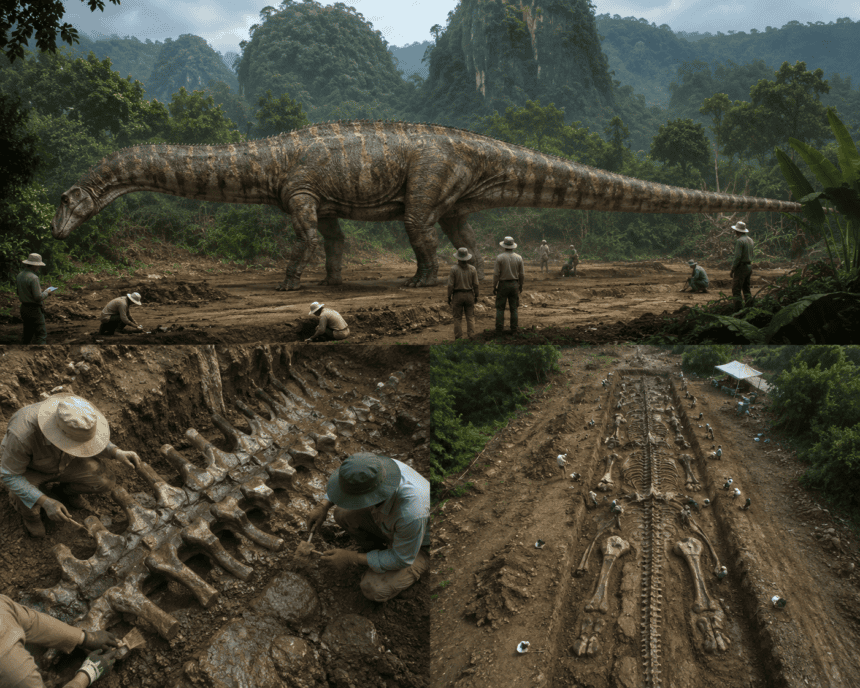
Paleontologists in Thailand have identified a new species of sauropod, a colossal herbivore measuring roughly 22 meters—the length of a standard cricket pitch. The discovery, unearthed in the northeastern province of Kalasin, offers a fresh look at the prehistoric giants that once roamed Southeast Asia.
The specimen, named *Phuwiangvenator yaemniyomi*—though colloquially linked to the site’s unique geological layers—was found embedded in rock formations that date back to the Early Cretaceous period, roughly 130 million years ago. Researchers spent months carefully extracting the fossilized remains from the site, which has long been a hotspot for dinosaur discoveries.
This isn’t just another set of bones. The sheer scale of the skeleton provides evidence of a thriving ecosystem in what is now Thailand’s Isan region. The creature’s massive neck and tail structure suggest it was an apex grazer, capable of reaching high canopy vegetation that smaller herbivores couldn’t touch.
“The preservation of the vertebrae is exceptional,” said one lead researcher involved in the excavation. “It allows us to map the biomechanics of these animals with a precision we rarely get from fragmented finds.”
While Thailand has yielded several dinosaur fossils in the past, this particular find stands out for its completeness. Most remains in this region are scattered or eroded. Finding a significant portion of a 22-meter-long titan provides a rare baseline for comparing Southeast Asian sauropods to their better-known cousins in China and South America.
The bones are currently undergoing intensive analysis at the Sirindhorn Museum. Experts there are already comparing the pelvic structure to other known sauropods to determine exactly where this species fits on the evolutionary tree.
For now, the find confirms that the lush, river-fed landscapes of ancient Thailand supported some of the largest land animals to ever walk the earth. As the analysis continues, the focus shifts to what this species ate and how it interacted with the smaller, predatory dinosaurs that shared its territory.
The site in Kalasin remains under guard, with geologists expecting further excavations to reveal more of the skeleton—and potentially, more secrets about the giants of the Cretaceous.