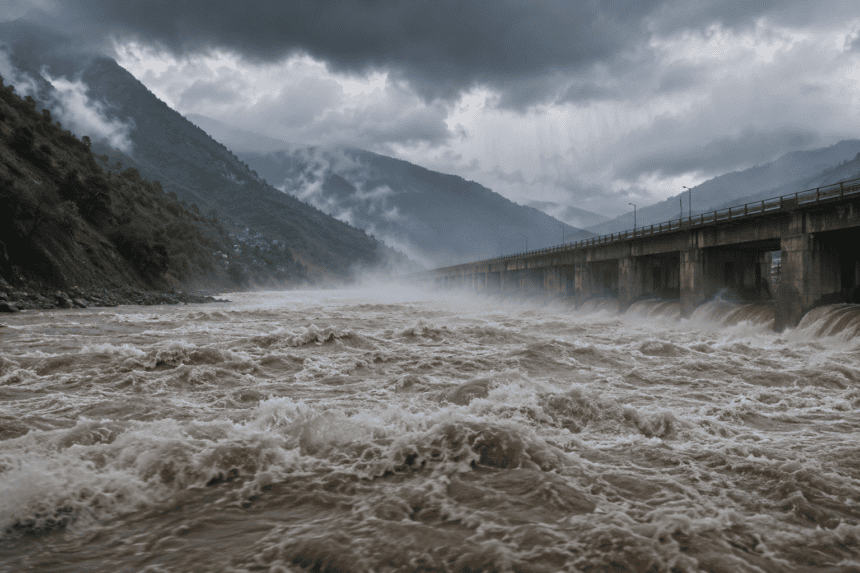
The Provincial Disaster Management Authority (PDMA) has issued an urgent flood warning for districts along the Chenab River, following relentless monsoon rainfall across Indian-occupied Kashmir and the upper reaches of Punjab.
Water levels at the Marala Headworks are rising rapidly. Officials report an inflow of over 100,000 cusecs, a figure expected to climb as runoff from the catchment areas moves downstream. District administrations in Sialkot, Gujrat, and Hafizabad are on high alert, with emergency response teams deployed to low-lying areas near the riverbanks.
The surge presents an immediate threat to riverine settlements. Many residents in these areas, particularly those living in katcha houses, have been advised to relocate to higher ground before nightfall. The Irrigation Department has cancelled all staff leaves, citing the need for round-the-clock monitoring of embankments.
“We are tracking the discharge from Marala every hour,” said a senior official at the Flood Forecasting Division. “The challenge isn’t just the current volume; it’s the speed at which the water is accumulating. We’re looking at a potential ‘medium-level’ flood threat within the next 24 hours.”
While the authorities have initiated warning sirens in vulnerable villages, communication remains a hurdle. Many remote communities along the Chenab lack reliable access to real-time updates, relying instead on local mosque loudspeakers and word-of-mouth.
This spike follows an unusually wet monsoon season that has already saturated the soil, leaving little capacity for the ground to absorb further rainfall. With the India Meteorological Department predicting continued downpours in the upper catchment basins, the pressure on the Marala and Khanki barrages is unlikely to subside before the weekend.
For the farming communities along the Chenab, the timing is particularly brutal. Standing crops in the riverine belts face total destruction if the water breaches the banks.
The PDMA has directed all deputy commissioners to clear encroachments from the floodplains immediately. Whether those orders are carried out in time to prevent loss of life and property depends entirely on the next few hours of flow data.