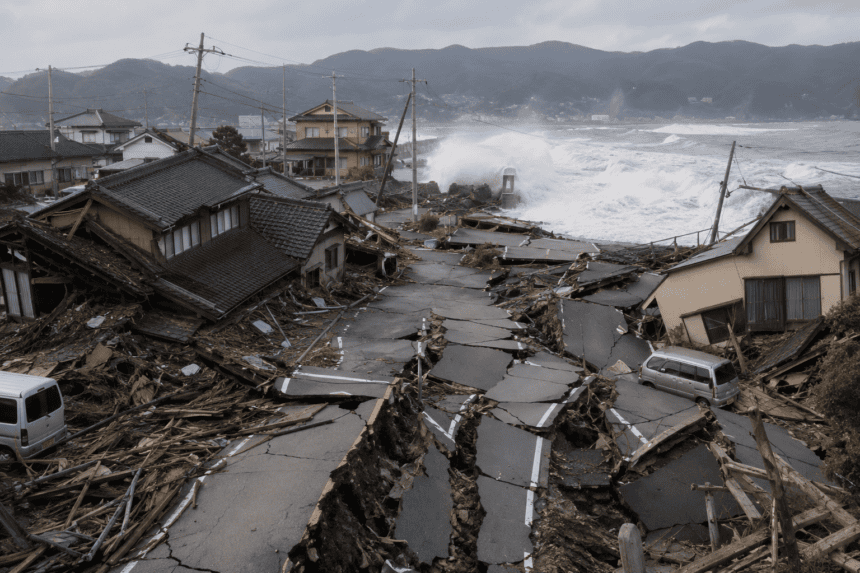
MIYAZAKI, Japan — A 7.1 magnitude earthquake struck off the coast of Kyushu on Thursday, triggering tsunami advisories and forcing a frantic scramble for higher ground across the country’s southwest.
The Japan Meteorological Agency (JMA) pinpointed the epicenter in the Hyuga-nada Sea at a depth of roughly 30 kilometers. Residents in Miyazaki and surrounding prefectures reported violent shaking that lasted for nearly a minute, enough to send furniture sliding and shatter windows in older coastal structures.
The immediate concern remains the threat of rising water. Authorities issued a tsunami advisory for the Pacific coast of Kyushu and Shikoku, warning of waves up to one meter. While the initial warnings were localized, the Japan Railways group immediately suspended Shinkansen bullet train operations in the region as a precaution, leaving thousands of commuters stranded as engineers began the tedious process of checking tracks for structural damage.
This tremor is particularly concerning because of its location. It occurred along the edge of the Nankai Trough, a subduction zone stretching from Shizuoka to Kyushu. Seismologists have long warned that a major rupture along this trough could produce a “megathrust” earthquake, potentially impacting vast swaths of the Japanese archipelago.
“We are currently assessing the structural integrity of critical infrastructure, including nuclear facilities in the region,” a government spokesperson said during a brief press briefing in Tokyo. So far, the Kyushu Electric Power Company has reported no abnormalities at its Sendai nuclear plant, though operations remain under close observation.
The human toll is still being tallied. Local fire departments in Miyazaki have received reports of minor injuries from falling objects and debris, but there have been no immediate confirmations of fatalities. Search and rescue teams are currently moving through coastal towns, checking on elderly residents who may have struggled to evacuate when the sirens began to wail.
For a nation that lives with the constant reality of seismic activity, the psychological impact of this event is sharp. The government’s Earthquake Research Committee is expected to convene an emergency session later today to determine if this quake is a precursor to a larger event or an isolated incident.
For now, the advice from the JMA is blunt: stay away from the coastline. The threat of aftershocks remains high, and in the shadow of the Nankai Trough, the authorities aren’t taking any chances.