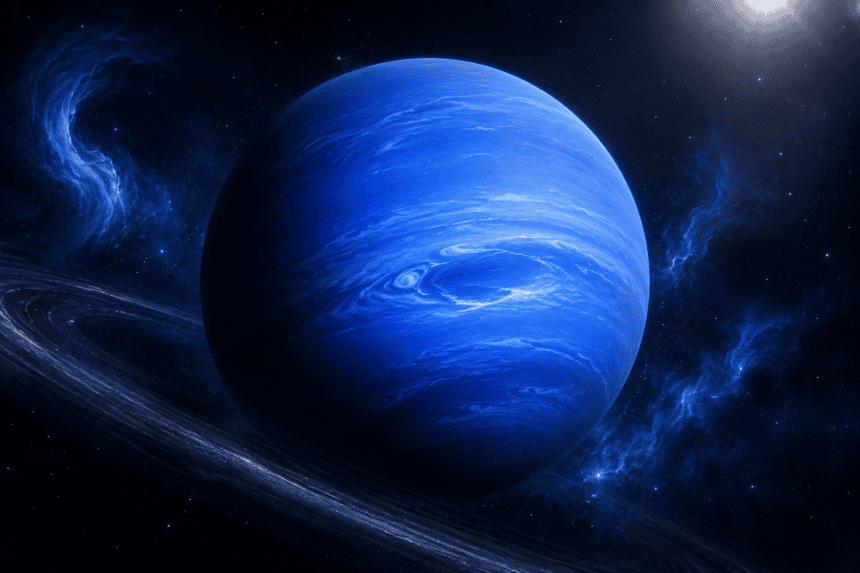
Scientists have uncovered new insights into the mysterious atmosphere of Neptune, the eighth and most distant major planet in our Solar System. The latest research is helping astronomers better understand the planet’s powerful winds, dynamic weather patterns, cloud formations, and atmospheric composition.
Using observations from advanced space telescopes and ground-based observatories, researchers analyzed Neptune’s atmosphere across multiple wavelengths of light. The findings revealed new details about the movement of methane clouds, temperature variations, and the complex circulation of gases deep within the planet.
Neptune is well known for having some of the strongest winds in the Solar System, with wind speeds reaching more than 2,000 kilometers per hour (1,200 mph). Scientists are still investigating how these extreme winds are generated despite the planet receiving very little heat from the distant Sun.
Researchers found that methane gas in Neptune’s atmosphere absorbs red light while reflecting blue wavelengths, giving the planet its striking deep-blue appearance. They also observed seasonal changes in cloud activity, suggesting that Neptune’s atmosphere is more dynamic than previously believed.
The study provides fresh clues about the interaction between the planet’s atmosphere, internal heat, and magnetic field. Scientists believe that heat rising from Neptune’s interior plays a significant role in driving its powerful storms and constantly changing weather systems.
Astronomers emphasize that studying Neptune helps improve our understanding of the ice giant planets, a category that also includes Uranus. These discoveries may also provide valuable insights into similar exoplanets found orbiting distant stars throughout the galaxy.
Experts say future space missions and more advanced telescopes will continue to reveal new information about Neptune, bringing scientists closer to understanding one of the Solar System’s most distant and mysterious worlds.