Scientists have uncovered new secrets about Mercury, the smallest and innermost planet in the Solar System, offering fresh insights into its formation, geological history, magnetic field, and extreme environment. The latest research is helping astronomers better understand how this rocky world evolved over billions of years despite its harsh conditions.
Using data collected by spacecraft, including NASA’s MESSENGER mission and observations supporting the ongoing BepiColombo mission, researchers analyzed Mercury’s surface, interior, and magnetic field. The findings reveal new details about the planet’s composition and the processes that have shaped it since the early days of the Solar System.
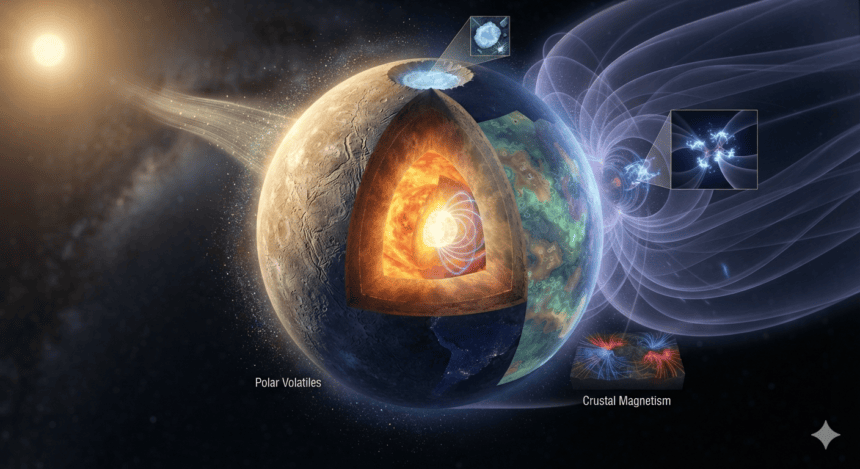
Mercury is only about 4,880 kilometers (3,032 miles) in diameter, making it the smallest planet in the Solar System. Despite its size, it possesses an unusually large iron core that occupies much of the planet’s interior. Scientists believe this massive core plays a key role in generating Mercury’s surprisingly strong magnetic field.
The study also found evidence that Mercury’s surface continues to change. Massive cliffs, known as lobate scarps, indicate that the planet has slowly shrunk over time as its interior cooled and contracted. These geological features provide valuable clues about Mercury’s internal evolution.
Researchers examined the planet’s heavily cratered landscape, which records billions of years of impacts from asteroids and comets. Unlike Earth, Mercury has almost no atmosphere to protect its surface, allowing ancient impact craters to remain well preserved.
Scientists also continue to investigate the presence of water ice hidden inside permanently shadowed craters near Mercury’s poles. Although the planet experiences daytime temperatures exceeding 430°C (806°F), these permanently dark regions remain cold enough to preserve frozen water.
Experts say studying Mercury helps scientists better understand the formation of rocky planets, including Earth, Venus, and Mars. The discoveries also provide valuable information about how planets evolve under intense heat and radiation close to their parent stars.
Future observations by the BepiColombo mission, a joint project of the European Space Agency (ESA) and the Japan Aerospace Exploration Agency (JAXA), are expected to reveal even more about Mercury’s geology, magnetic field, and mysterious interior.