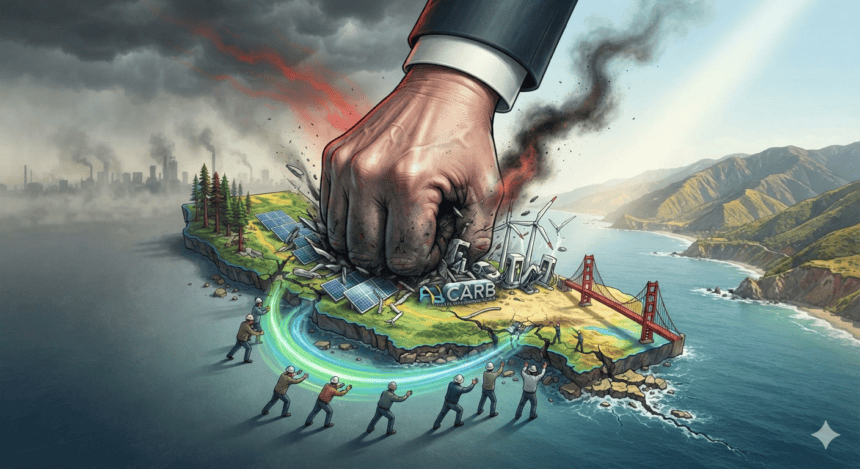
Donald Trump is moving to dismantle California’s long-standing authority to set its own vehicle emissions standards, setting the stage for a protracted legal showdown that could reshape the American auto industry.
The former president has signaled he will revoke the Clean Air Act waiver granted to the state, a move that would effectively force California to align its environmental regulations with weaker federal standards. For decades, the Golden State has leveraged this waiver to mandate a phase-out of gas-powered cars by 2035—a policy that has influenced the manufacturing strategies of major automakers globally.
The maneuver isn’t just about tailpipe emissions; it’s a direct strike at the economic leverage California holds over the national market. By compelling manufacturers to produce cleaner vehicles to meet California’s mandates, the state has essentially driven the national trend toward electrification. Trump’s team views this as an overreach that stifles domestic manufacturing and complicates production lines for companies that prefer a uniform federal rulebook.
“California shouldn’t be allowed to dictate national energy policy,” a transition advisor close to the campaign said, speaking on condition of anonymity to discuss internal planning. “We want a single, competitive market where the federal government sets the floor, not a state-level bureaucracy.”
Industry analysts expect the battle to center on the legal interpretation of the Clean Air Act. California officials have already promised to challenge any revocation in federal court, arguing that the state’s unique geography and historical pollution challenges justify its more stringent approach. Attorney General Rob Bonta has signaled his office is prepared to file for an injunction the moment any executive order is signed.
The stakes extend beyond state lines. If the Trump administration successfully strips California of this power, it could trigger a “race to the bottom” in environmental standards. Automakers, long frustrated by the “two-state” regulatory environment—one for California and its allies, and one for the rest of the country—might welcome the relief, even if it forces them to walk back multi-billion dollar investments in electric vehicle (EV) infrastructure.
Environmental advocates argue the move ignores the reality of the climate crisis. They point to the state’s recent history of wildfires and record-breaking heat as evidence that the policy isn’t just a political preference, but a necessity for public health.
The confrontation is set to test the limits of executive power. While Trump may have the authority to challenge the waiver, the courts have been hesitant in the past to strip states of their historical regulatory rights without clear congressional backing.
For now, the automotive industry remains in a state of nervous anticipation. They are waiting to see if they will be forced to pivot their production lines back toward internal combustion engines, or if California’s legal defense will hold firm against the incoming administration.