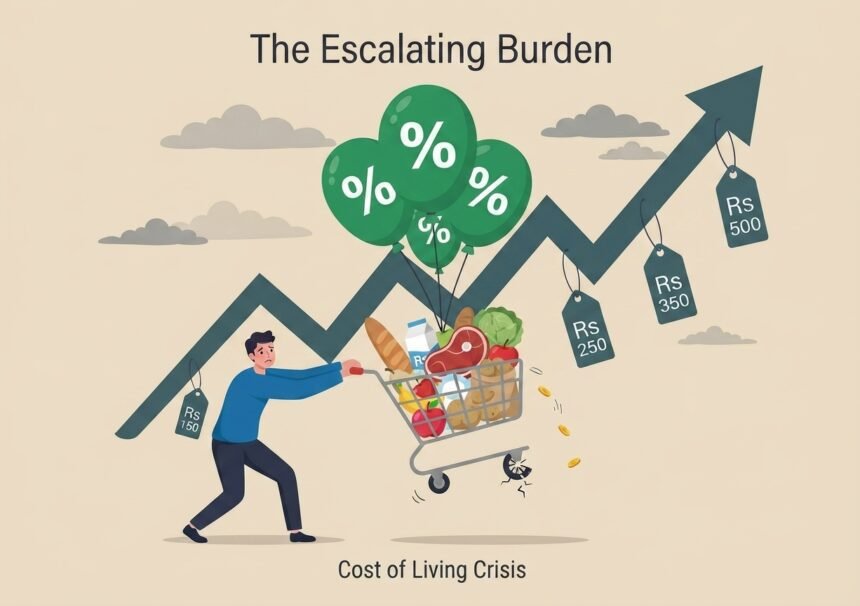
KARACHI: Pakistan’s Sensitive Price Indicator (SPI) remained elevated at 9.66% year-on-year for the week ended August 20, 2026, with lower-income households facing greater inflationary pressure as food and energy prices continued to rise.
According to the Pakistan Bureau of Statistics (PBS), the overall SPI increased 0.49% week-on-week.
For households in the lowest consumption group, with monthly expenditure of up to Rs17,732, annual inflation stood at 9.87%. The second-lowest group experienced the highest year-on-year increase of 10.36%, both above the national average.
Higher-income groups recorded comparatively lower inflation, ranging between 9.03% and 9.33%.
The weekly increase was mainly driven by higher prices of onions, which rose 14.17%, petrol 3.77% and chicken 3.35%. Garlic, gram pulse, prepared tea and milk also became more expensive.
On the other hand, egg prices declined 5.78%, diesel fell 5.15%, tomatoes dropped 4.99% and potatoes decreased 1.17%.
Of the 51 essential items monitored across 50 markets in 17 cities, prices of 23 items increased, while 10 declined and 18 remained unchanged.
On an annual basis, food prices remained a major source of pressure. Onion prices jumped 132.52%, tomatoes increased 93.21% and wheat flour rose 62.25%.
Energy costs also recorded significant increases. LPG prices surged 51.69%, diesel rose 33.08% and petrol increased 27.65% compared with the same period last year. Electricity charges for households in the lowest consumption category increased 22.72% year-on-year.
The higher prices have placed a greater burden on low-income families, which allocate a larger proportion of their household budgets to food and fuel.
The SPI for the lowest consumption group stood at 350.03 points, compared with 318.59 points a year earlier, while the overall index reached 360.90 points.
Meanwhile, Growth Securities expects Pakistan’s National Consumer Price Index (NCPI) for August 2026 to rise by 11% year-on-year and 1% month-on-month.
According to Growth Securities’ Head of Research Nasheed Malik, the expected monthly increase is mainly linked to higher food prices, with rising petrol and diesel costs likely to add further pressure on overall inflation.
The continued rise in essential food and energy prices is expected to remain a key concern for households and policymakers in the coming weeks.