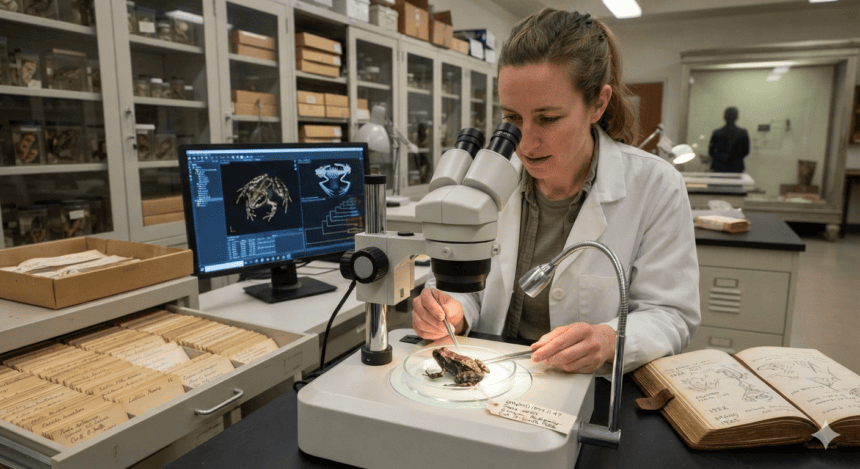
A frog that sat inside a glass jar at the Natural History Museum in London for over 100 years has finally been identified as a distinct species. Researchers confirmed the specimen, originally collected in 1902, belongs to a previously unknown lineage of the *Hylidae* family.
The discovery highlights a quiet reality of modern taxonomy: the answers to today’s biodiversity questions are often sitting in storage, waiting for the right pair of eyes and newer genetic tools to catch up.
Genetic sequencing revealed that the frog, which had been misidentified for decades, carries unique DNA markers that set it apart from its closest relatives in Central and South America. While the specimen was initially filed away as a common species, its physical characteristics—specifically its distinct toe structure and skin pigmentation—hinted at something different.
“We often assume that everything in our cabinets has been named,” said Dr. Elena Rossi, the lead researcher on the study. “But the reality is that we are still catching up to the diversity that was collected a century ago.”
The frog’s origin remains a point of interest. Field notes from the original 1902 expedition were sparse, leaving scientists to reconstruct the creature’s natural habitat through environmental DNA analysis of the fluid it was preserved in. These findings suggest the species likely inhabited the cloud forests of the Andes, a region known for its high concentration of endemic life.
This misidentification isn’t an isolated case. Thousands of specimens worldwide remain mislabeled in museum collections, trapped in a bureaucratic limbo that masks the true scale of historical biodiversity.
The team now plans to revisit the original collection site in the Andes to see if a living population still exists. If they find one, it would mark a rare second chance for a species that has been hidden from science for more than a hundred years.