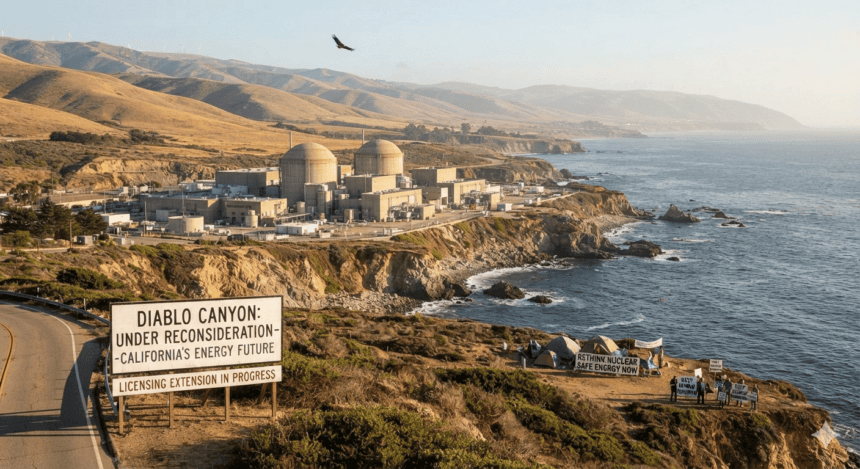
California’s long-standing hostility toward nuclear power is fracturing under the weight of an inescapable reality: the state’s aggressive climate goals are currently physically impossible without the Diablo Canyon Power Plant.
For years, state policy centered on a phase-out of the facility, which provides roughly 9% of California’s total electricity. That plan is now effectively dead. Governor Gavin Newsom, once a staunch proponent of shuttering the plant, reversed course as the state’s grid faced repeated threats of blackouts during record-breaking heatwaves.
The shift isn’t just a change in political rhetoric; it is a multi-billion dollar acknowledgment of grid fragility.
Keeping Diablo Canyon open beyond its original 2025 retirement date comes with a massive price tag. Legislators authorized a $1.4 billion forgivable loan to Pacific Gas & Electric (PG&E) to keep the reactors running through 2030. It’s a steep premium to pay for a technology the state spent a decade trying to discard.
Critics of the extension point to the cost of seismic retrofitting and the unresolved issue of long-term radioactive waste storage. They argue that the $1.4 billion could have been better spent on battery storage and offshore wind projects.
Proponents, however, point to the data. Solar power is abundant during the day but vanishes when the sun sets—exactly when energy demand peaks as residents return home and crank up air conditioning. Battery storage is expanding, but not nearly fast enough to replace the baseload power Diablo Canyon provides 24/7.
“We were looking at a reliability cliff,” said one energy analyst familiar with the grid’s capacity planning. “The state realized that if they didn’t keep the lights on, the political fallout from a massive grid failure would be far worse than the backlash from extending a nuclear plant.”
The state is now caught in a transition paradox. California wants to lead the nation in renewables, but it’s currently relying on a 1980s-era nuclear plant to provide the stability that modern wind and solar farms lack.
The extension of Diablo Canyon is a temporary stopgap, not a long-term embrace of nuclear energy. The state’s legislative roadmap still points toward a future dominated by solar, wind, and battery storage. But for now, the reality of the grid has forced California to cling to the very source of power it once vowed to abandon.
Whether this keeps the lights on long enough for renewables to catch up remains the central question for the state’s energy future. For now, California is buying time, and it’s paying a premium to do it.