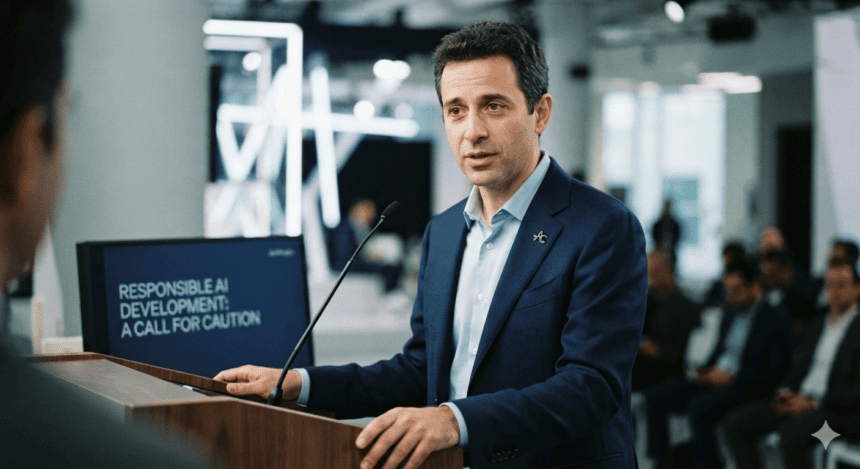
Dario Amodei, the CEO of Anthropic, has issued a blunt warning to the tech industry: the current pace of AI development is unsustainable. He argues that companies are prioritizing speed over the necessary safety infrastructure required to manage increasingly powerful models.
For years, the industry mantra was “move fast and break things.” Amodei says that approach is a liability when applied to systems capable of sophisticated reasoning and autonomous task execution. He isn’t calling for a total halt, but rather a deliberate recalibration. His argument centers on a simple premise: if we don’t understand the inner workings of these models, we shouldn’t be rushing to deploy them at scale.
The shift in tone from a major industry leader is notable. Anthropic, the firm behind the Claude AI series, has marketed itself specifically on “constitutional AI”—a design philosophy aimed at aligning model outputs with human values. By pushing for a slowdown, Amodei is effectively telling his rivals that the race for market share is creating systemic risks that no single company can mitigate alone.
Technical experts have long pointed to the “black box” problem—the reality that even the engineers building these neural networks can’t fully explain why a model produces a specific output. Amodei’s stance acknowledges this reality. He suggests that if developers ignore the lack of transparency, they risk releasing systems that could be manipulated or behave in ways that cause real-world harm.
Critics of this “safety-first” approach argue that slowing down creates a power vacuum. They contend that if Western firms hit the brakes, it only provides an opening for less-regulated actors, potentially in countries with fewer ethical guardrails, to seize the lead. It’s a classic prisoner’s dilemma: every firm wants safety, but no firm wants to be the one that falls behind in the race for AGI—Artificial General Intelligence.
Amodei’s intervention moves the debate away from abstract sci-fi fears and toward immediate corporate responsibility. He is pushing for a future where safety testing is as integral to the development cycle as the training of the models themselves.
Whether his competitors will follow suit remains the central question. For now, the push for growth remains the primary incentive for the tech giants funding these models. Amodei’s call serves as a reminder that in the rush to build the next generation of intelligence, the industry may be ignoring the very foundations meant to keep it under control.