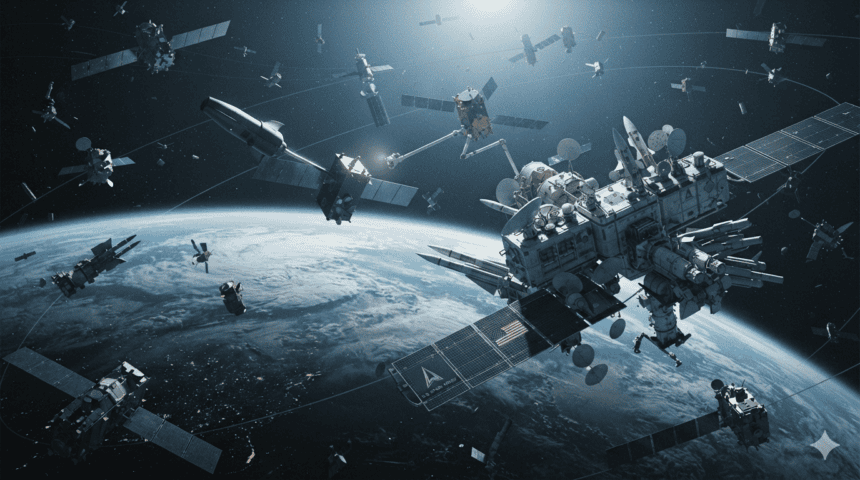
Washington: Concerns over a potential space arms race are growing after the United States confirmed that it has deployed weapons in Earth’s orbit capable of supporting space-control operations.
The announcement marks a significant development in military space policy and has raised concerns among experts that the United States, China and Russia could increasingly compete to develop and deploy weapons designed to disrupt or disable each other’s satellites.
US Confirms Weapons in Orbit
US officials have confirmed the presence of on-orbit space-control weapons, but have not disclosed detailed information about their number, location or specific capabilities.
US Secretary of the Air Force Troy Meink said the systems are intended to help protect American forces and space assets from potential attacks.
Officials have presented the capability as part of a broader effort to strengthen deterrence — essentially making potential adversaries think twice before targeting US satellites or other space-based infrastructure.
What Kind of Weapons Are Involved?
The US has not publicly explained exactly what the newly confirmed systems can do.
Space-control technology can include a range of capabilities, such as systems designed to interfere with satellite communications, disrupt sensors, jam signals or otherwise prevent an opposing satellite from operating effectively.
More destructive anti-satellite weapons can physically damage or destroy satellites, although such attacks can create large amounts of orbital debris.
That debris can remain in space and potentially threaten other satellites, including those belonging to countries not involved in a conflict.
Why China and Russia Are a Concern
The United States has increasingly identified China and Russia as major competitors in space.
Both countries have developed technologies capable of threatening satellites. Russia has previously demonstrated an anti-satellite capability by destroying one of its own defunct satellites with a missile in 2021, producing thousands of pieces of trackable debris.
China has also conducted tests and developed sophisticated space capabilities, prompting Washington to increase investment in systems designed to protect US satellites.
China Warns Against Militarising Space
China has repeatedly criticized what it describes as efforts to turn space into another battlefield.
Beijing has called for greater international cooperation to prevent an arms race in outer space and has accused the United States of increasing militarisation.
The US, meanwhile, argues that it needs to maintain the ability to defend its satellites because space has become essential to modern military operations.
Why Satellites Matter So Much
A conflict in space could have consequences far beyond military operations.
Satellites support many everyday and strategic services, including:
- GPS and navigation
- Communications
- Weather forecasting
- Internet and telecommunications
- Banking and financial systems
- Military surveillance
- Missile-warning systems
If satellites were deliberately disrupted or destroyed during a conflict, both military and civilian systems could be affected.
The Danger of Space Debris
One of the biggest concerns surrounding anti-satellite weapons is orbital debris.
When a satellite is destroyed, thousands of fragments can travel around Earth at extremely high speeds. These fragments can collide with other spacecraft and create even more debris.
In a worst-case scenario, a chain reaction could make certain orbital regions increasingly difficult and dangerous to use.
This is one reason experts distinguish between technologies that temporarily disrupt a satellite and weapons that physically destroy it.
What Does International Law Say?
The 1967 Outer Space Treaty prohibits countries from placing nuclear weapons and other weapons of mass destruction in orbit.
However, it does not impose a comprehensive ban on every type of conventional or anti-satellite weapon.
That has left room for countries to develop a wide range of counter-space capabilities, including electronic, cyber and other technologies.
Could This Trigger a New Arms Race?
Experts fear that the US confirmation could encourage other major powers to accelerate their own programmes.
If the United States deploys more space-control weapons, China and Russia could respond with additional defensive and offensive capabilities. That could create a cycle in which each country develops new systems because it believes its rivals are gaining an advantage.
The result could be a much more heavily militarised space environment.
What Happens Next?
The key challenge for governments will be finding a balance between protecting satellites and preventing an uncontrolled arms race.
Military planners argue that credible defensive capabilities can discourage attacks. Critics, however, warn that deploying weapons in orbit could increase mistrust and make future conflicts more likely.
The latest US announcement therefore raises a much bigger question: Will space remain primarily an area for communication, exploration and scientific cooperation — or become another major battlefield between competing powers?