By using this site, you agree to the Privacy Policy and Terms of Use.
Accept
Media HydeMedia Hyde
  • Home
  • Politics
  • Education
  • Entertainment
  • Sports
  • Blogs
  • Business & Commerce
  • Others
    • Religious
    • Metropolitan
    • Climate and Weather
Font ResizerAa
Media HydeMedia Hyde
Font ResizerAa
  • Home
  • Politics
  • Education
  • Entertainment
  • Sports
  • Blogs
  • Business & Commerce
  • Others
    • Religious
    • Metropolitan
    • Climate and Weather
Follow US
© 2026 Media Hyde Network. All Rights Reserved.
Climate and WeatherHeadline

Bleached Coral Rebounded After Touching Healthy Coral, Study Finds

Last updated: October 15, 2026 12:11 am
Ayesha Masood
Share
Bleached Coral Rebounded After Touching Healthy Coral, Study Finds
SHARE

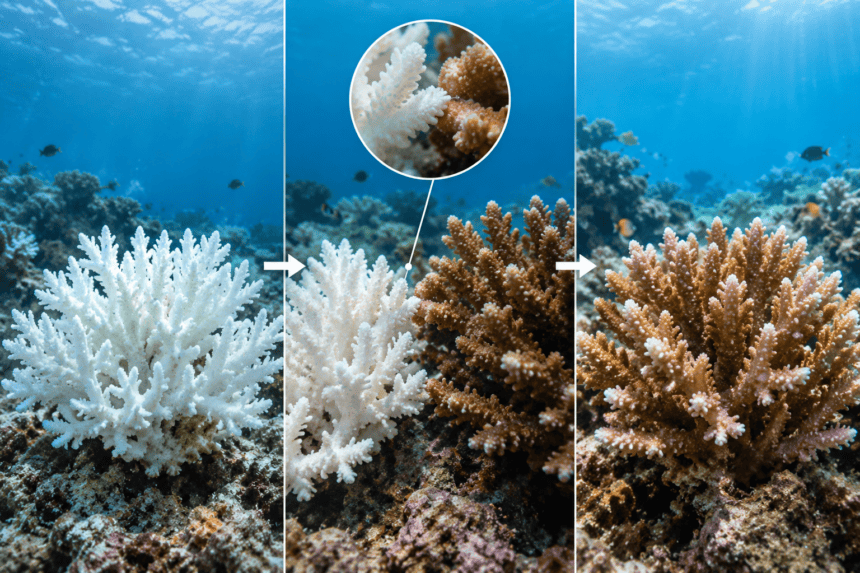
Coral reefs under heat stress have a chance at recovery through an unlikely mechanism: physical contact with healthy neighbors. A study published in *Nature Communications* reveals that bleached corals can regain their color and vitality significantly faster when they come into contact with non-bleached counterparts.

Researchers at the University of Queensland observed that the transfer of essential nutrients or biological signals occurs during these physical interactions. For years, the prevailing view held that bleached corals were largely passive victims of rising ocean temperatures. This finding shifts that perspective, suggesting that reef structures act more like a collaborative network than a collection of isolated organisms.

The study focused on *Pocillopora* corals, commonly found in the Pacific. When a bleached colony touched a healthy one, the stressed coral showed a 30% increase in recovery speed compared to those left in isolation.

“We aren’t just looking at structural support,” said Dr. Alexia Graba-Landry, lead author of the study. “There is a literal exchange happening at the tissue level that helps the weaker coral get back on its feet.”

This discovery challenges current restoration strategies. Most conservation efforts focus on planting coral fragments in grids, often spacing them out to prevent competition for space. If physical contact is a catalyst for recovery, these spacing guidelines may actually hinder the reef’s natural defense mechanisms against heatwaves.

The implications for global reef management are immediate. As marine heatwaves become more frequent, scientists are now looking at whether “clustering” corals during restoration projects could provide a survival advantage. By forcing contact, conservationists might be able to create “nursing” clusters that help weaker corals survive the initial shock of a bleaching event.

While this mechanism offers a glimmer of hope, it is not a panacea. The study confirms that if the water temperature remains too high for too long, no amount of physical contact can save the colony.

Even with this biological boost, the fundamental driver remains the same: if the oceans don’t cool, the networks will eventually fail. For now, the research provides a new tool for those trying to keep reefs alive in a warming world.

Share This Article
Email Copy Link Print
Previous Article Industrial fire linked to fish and eels' deaths Industrial fire linked to fish and eels’ deaths
Next Article Meta changes Threads feed to prioritize posts from followed creators Meta changes Threads feed to prioritize posts from followed creators
Leave a Comment

Leave a Reply Cancel reply

Your email address will not be published. Required fields are marked *

Sponsored Ads

Stay Connected

FacebookLike
XFollow
InstagramFollow
YoutubeSubscribe
WhatsAppFollow
ThreadsFollow
Darshan Raval's latest single 'Naal Naal Ve' explores love, longing, reality
Darshan Raval’s latest single ‘Naal Naal Ve’ explores love, longing, reality
Entertainment Headline
October 15, 2026
Ukraine’s Vulnerability Grows as Starlink Is Restricted and Russia Escalates
Headline Politics
October 15, 2026
World’s oldest known shipwreck found in Turkiye
Headline Maritime
October 15, 2026
Human extinction risks include malicious AI and nuclear famine in new Lancet data
Headline Technology
October 15, 2026
Petrol price rises, diesel rate falls in Pakistan
Economy Headline
October 15, 2026
Meta changes Threads feed to prioritize posts from followed creators
Breaking
October 15, 2026

You Might Also Like

Climate and Weather

China’s CO2 emissions have been flat or falling for past 18 months, analysis finds

By
Anoosha Malik
Afridi vows to reach Karachi despite Sindh govt’s blockade
HeadlinePolitics

Afridi vows to reach Karachi despite Sindh govt’s blockade

By
Ayesha Masood
Another blow for motorists as OGRA hikes petrol, diesel prices
EconomyHeadline

Another blow for motorists as OGRA hikes petrol, diesel prices

By
Haris Ali
2026 Matriculation Results: Where and How to Check Your Scores
EducationHeadline

2026 Matriculation Results: Where and How to Check Your Scores

By
Haris Ali
Media Hyde Media Hyde Dark
Facebook Twitter Youtube Rss Medium

About US

Media Hyde Network: Your instant connection to breaking stories and live updates. Stay informed with our real-time coverage across politics, tech, entertainment, and more. Your reliable source for 24/7 News.

Top Categories
  • Headline
  • Politics
  • Entertainment
  • Education
  • Sports
  • Religious
  • Metropolitan
  • Climate and Weather
Usefull Links
  • Contact Us
  • Disclaimer
  • Privacy Policy
  • Cookies Policy
  • Advertising Policy
  • Terms & Conditions

© 2025 Media Hyde Network. All Rights Reserved.

Welcome Back!

Sign in to your account

Username or Email Address
Password

Lost your password?