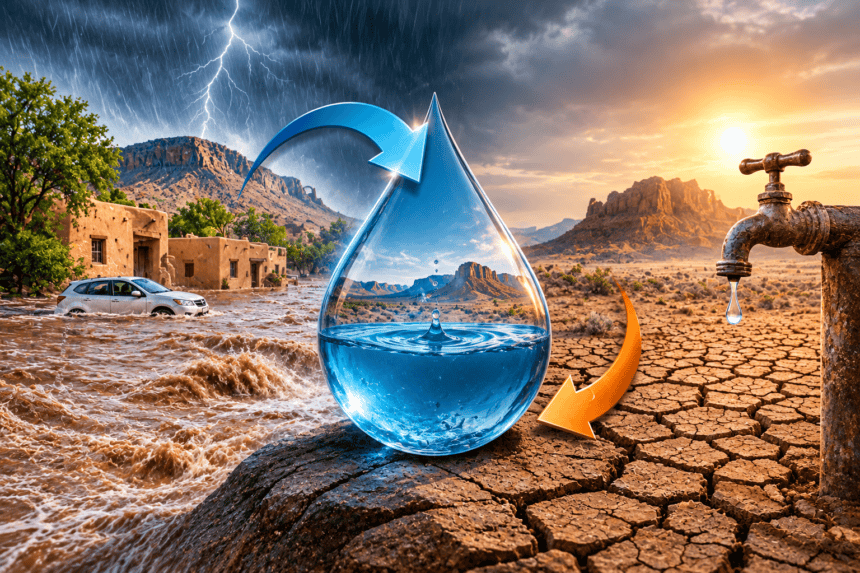
The American Southwest just endured a season of record-breaking rain and flash flooding. Roads washed out, reservoirs ticked upward, and the immediate threat of drought seemed to retreat. But the water won’t stay.
Hydrologists and state water managers are clear: a few months of intense rain cannot fix a structural deficit that has been building for decades. The Colorado River Basin, which provides water for 40 million people, remains in a state of long-term decline that no single weather event can reverse.
The problem lies in the soil. After years of extreme heat and arid conditions, the ground across the Southwest has become hydrophobic. When heavy rain hits, the parched earth acts like concrete. Instead of soaking into the aquifers—the underground storage tanks that cities rely on during dry years—the water rushes into drainage systems and evaporates or flows uselessly into the ocean.
“We are seeing a temporary spike in reservoir levels, but the underlying arithmetic hasn’t changed,” said a senior policy analyst at the Water Resources Center. “You don’t cure a chronic illness with a bandage.”
Data from the Bureau of Reclamation shows that while Lake Mead and Lake Powell have seen marginal gains, they remain at historic lows. Evaporation rates continue to climb alongside regional temperatures. Agriculture, which consumes roughly 70% of the Colorado River’s water, is still operating under infrastructure designed for a wetter century that no longer exists.
Municipalities are also trapped in a cycle of short-term relief. When reservoirs rise, the political urgency to implement strict conservation measures or update irrigation systems evaporates. It’s a dangerous complacency that keeps the region tethered to a boom-and-bust water cycle.
The climate trajectory for the region is hotter and drier. Even if the current storms bring short-term relief, they are outliers in a larger trend of aridification. The Southwest isn’t just experiencing a drought; it is undergoing a permanent transformation of its climate.
Until the region transitions from a model of consumption based on “what we have today” to one based on “what we can sustain tomorrow,” the next flood will only be a prelude to the next crisis. The water in the streets today is a reminder of what the region is losing, not what it has gained.