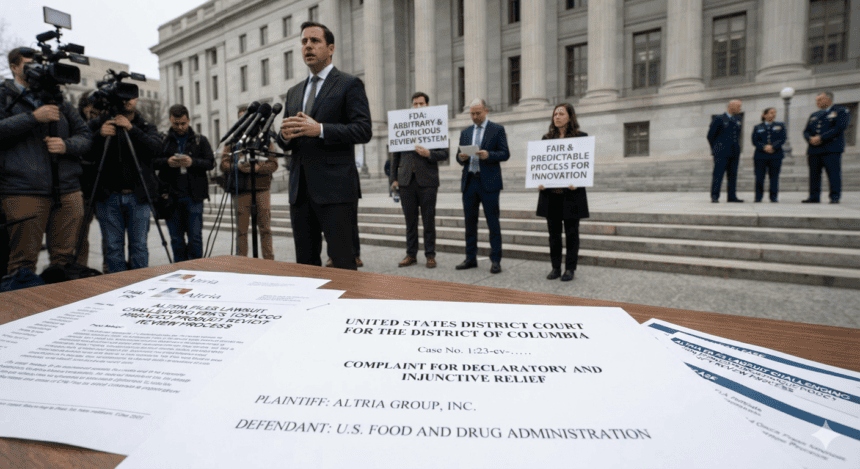
Altria Group is taking the Food and Drug Administration to court. The tobacco giant filed a lawsuit Tuesday in federal court, arguing the agency’s backlog of premarket tobacco product applications has created an illegal, indefinite delay that prevents it from bringing new products to market.
The company, which owns Philip Morris USA, claims the FDA has failed to act on thousands of applications for years. Altria contends this “de facto moratorium” on new products keeps potentially less harmful alternatives out of the hands of adult smokers while protecting existing, established products from competition.
At the heart of the dispute is the Premarket Tobacco Product Application (PMTA) process. Companies must prove to the FDA that a new product is “appropriate for the protection of public health” before it can be sold. Altria argues it has submitted the required data, yet the agency remains silent on critical filings, including those for various nicotine pouch and e-vapor offerings.
“The FDA’s inaction is not just a regulatory hurdle; it is a barrier to innovation,” a spokesperson for Altria said. The company is asking the court to compel the agency to reach a final decision on its pending applications within a set timeframe.
For the FDA, the massive influx of applications following the 2020 deadline created a logistical nightmare. The agency has struggled to process millions of submissions, focusing its limited resources on high-volume products like disposable vapes that have surged in popularity among youth.
Critics of the tobacco industry often point to this backlog as a result of companies flooding the agency with low-quality applications. Public health advocates argue that the FDA is rightfully exercising caution to prevent a new generation from becoming addicted to nicotine.
Altria’s legal maneuver signals a shift in strategy. Instead of waiting for the agency to clear its own path, the company is using the judicial system to force a timeline. If successful, the case could set a precedent that strips the FDA of its ability to sit on applications indefinitely.
The agency has not yet filed a formal response in court. For now, the backlog remains, leaving the industry and public health officials waiting on a ruling that could reshape the future of the U.S. tobacco market.