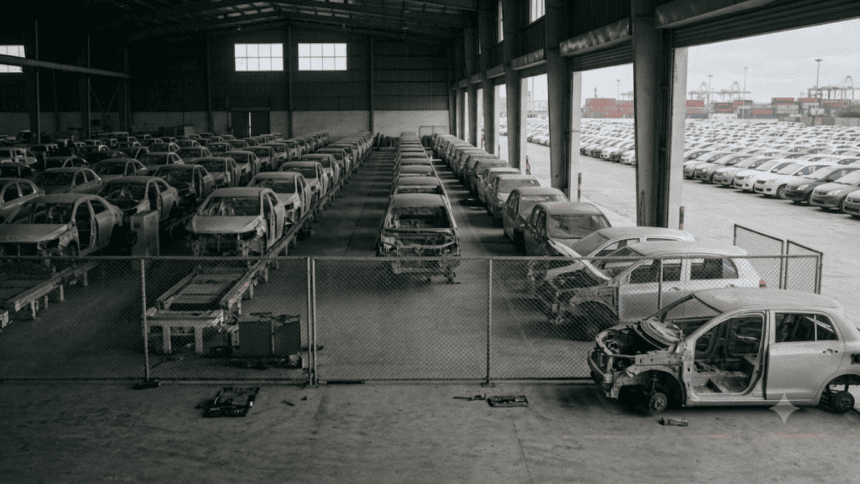
KARACHI — Pakistan’s automobile manufacturing sector has effectively ground to a halt due to critical delays in the announcement of a succession framework for the national auto policy, leaving local assemblers without clear regulatory guidance. Speaking on the ARY News program On My Radar, Ali Asghar Jamali, Chief Executive Officer of Indus Motor Company, revealed that a majority of vehicle assembly plants across the country have either completely shut down or suspended operations. While the government’s 2021–2026 Auto Industry Development Policy successfully broke the traditional corporate triad by attracting new Korean and Chinese manufacturers and boosting localized production, the looming expiry of its core financial incentives has triggered widespread industry paralysis.
A primary driver of the current crisis is the sudden spike in the sales tax on hybrid and plug-in hybrid electric vehicles (PHEVs), which jumped from a subsidized 8.5 percent to a staggering 25 percent. Jamali argued that short-term five-year industrial frameworks are fundamentally insufficient for high-capital manufacturing sectors, urging the government to implement 10-to-15-year policies to allow companies to realistically recover their investment costs. Furthermore, severe uncertainty regarding import tariffs persists; duties on both imported completely built-up (CBU) vehicles and locally assembled completely knocked-down (CKD) kits in the 800cc category sit at parity at 30 percent. Jamali warned that without the immediate issuance of critical statutory regulatory orders (SROs), a reduction of the hybrid sales tax to a balanced 18 percent, and targeted subsidies for low-income consumers buying smaller vehicles, manufacturers may permanently pivot away from domestic localization toward direct vehicle imports.