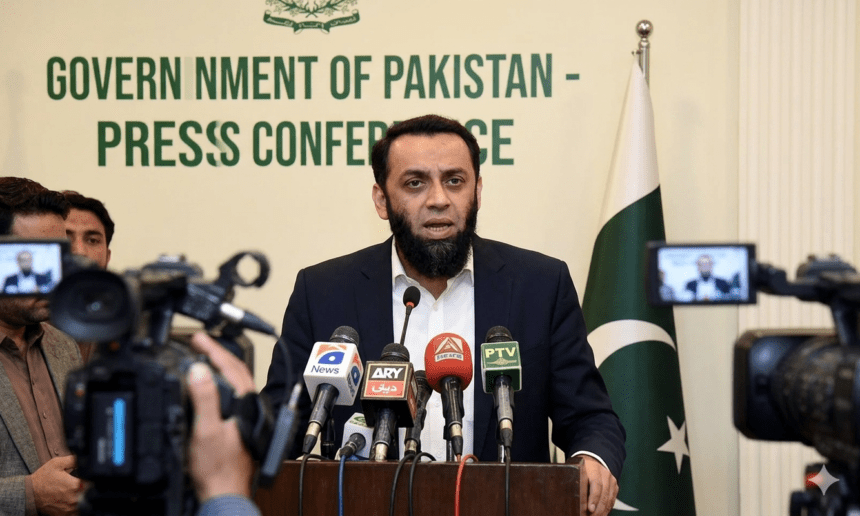
ISLAMABAD — Information Minister Attaullah Tarar on Wednesday strongly defended the proposed federal budget for the upcoming fiscal year, describing it as a “positive and relief-oriented” financial roadmap that steers Pakistan toward sustainable economic development and stability. Speaking at a joint press briefing with State Minister for Finance Bilal Azhar Kiani, Tarar dismissed critics of the budget and recalled the severe macroeconomic crisis the country faced just two years ago. He emphasized that the ruling Pakistan League-Nawaz (PML-N) leadership stepped in to stabilize the economy from the brink of default under the strategic vision of Nawaz Sharif, transitioning from absolute crisis management to active relief distribution.
The information minister highlighted an aggressive overhaul of the Federal Board of Revenue (FBR), targeting long-standing institutional challenges such as political appointments, corruption, and stalled digitization. Under the direction of Prime Minister Shehbaz Sharif, a strictly merit-based hiring system has been implemented across the board. Tarar detailed the transition to a completely “faceless system” at ports and income tax offices, enabling exporters to secure automated customs clearances within days without interacting with officials. Furthermore, the government has cracked down on tax-evading corporate sectors that were previously generating massive windfall profits. Key enforcement actions include:
-
Sugar Industry: Automated IT monitoring systems and cameras were deployed inside mills, introducing QR-code tracking for individual bags. This targeted digital enforcement generated Rs60 billion in tax revenue from sugar mills alone.
-
Tobacco Industry: Enforcement teams launched an aggressive crackdown on illegal tobacco networks to plug an estimated Rs200 billion fiscal leak.
-
Litigation and Recovery: Newly structured tribunals combined with updated judicial tracking enabled the state to vacate restrictive stay orders. This led to the direct recovery of over Rs800 billion through enforcement over the past year.
State Minister Bilal Azhar Kiani and Minister Tarar outlined targeted fiscal relief measures integrated into the new budget to protect low-to-middle income groups and incentivize domestic production. The core relief brackets encompass:
-
Salaried Class: Tax rates for individuals earning between Rs50,000 and Rs100,000 monthly have been fixed at a minimal 1%, with simultaneous tax slab reductions approved for the higher income brackets.
-
Exporters and Industry: The previously applicable advance tax alongside the corporate super tax has been completely abolished to bridge the national trade deficit and spur manufacturing.
-
Housing and Social Sector: Property taxes have been reduced for citizens buying small residential plots (5 to 10 marlas). Additionally, the government disbursed Rs90 billion to support the low-cost “Apna Ghar” housing scheme. The budget also completely abolished the “pink tax”—eliminating domestic duties on essential social welfare products like sanitary pads and contraceptives.
The fiscal roadmap is reinforced by a structural three-year freeze on provincial National Finance Commission (NFC) resource transfers to prioritize national security infrastructure. To broaden the tax net, the framework introduces new revenue structures on social media earnings, fixed tax models for small retailers, and strict regulatory barriers on luxury electric vehicle imports.