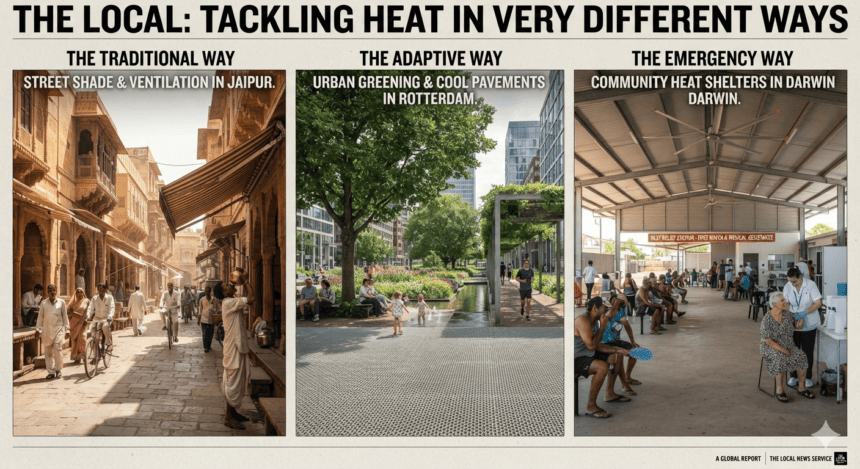
As global temperatures climb, the divide between how cities handle extreme heat is widening. Some are banking on high-tech infrastructure, while others are returning to ancestral wisdom to keep streets livable.
In Singapore, the government is leaning into “cool paint” technology. By coating building facades and pavements with reflective pigments, they’re aiming to drop ambient temperatures by up to two degrees Celsius. It’s a pragmatic, engineering-heavy approach designed for a dense, high-rise environment where green space is a luxury.
Meanwhile, in parts of the Middle East and North Africa, architects are reviving the use of “mashrabiya”—intricate lattice screens that provide shade while allowing airflow. These aren’t just aesthetic choices; they are functional thermal regulators that bypass the need for energy-intensive air conditioning. In cities like Seville, Spain, officials are testing similar ancient concepts, installing large overhead fabric canopies across popular pedestrian thoroughfares to create “cool corridors” during the peak afternoon sun.
The disparity in strategy highlights a fundamental shift in urban planning. Wealthier, tech-focused hubs often prioritize gadgets and materials, hoping to “engineer” their way out of the heat. Conversely, older cities in arid climates are proving that sometimes the most effective way to beat the heat is to work with the wind rather than fighting it.
Data from the World Meteorological Organization suggests that by 2050, over two-thirds of the global population will live in urban areas. This makes the “cooling race” a survival issue rather than a matter of comfort. Relying solely on air conditioning isn’t just unsustainable; it’s a feedback loop that pumps waste heat back into the streets, further raising the temperature for those who can’t afford to stay indoors.
Some planners are now advocating for a hybrid model. This involves “sponge city” designs—increasing permeable surfaces and urban forests to absorb heat—combined with passive cooling architecture. It’s an admission that no single technology can solve the problem.
The common denominator across these disparate efforts is a departure from the mid-century obsession with glass-and-steel boxes. Whether it’s a reflective coating in Singapore or a shaded alleyway in Seville, the goal is the same: reclaiming the street for people who can no longer afford to be burned by the sun.