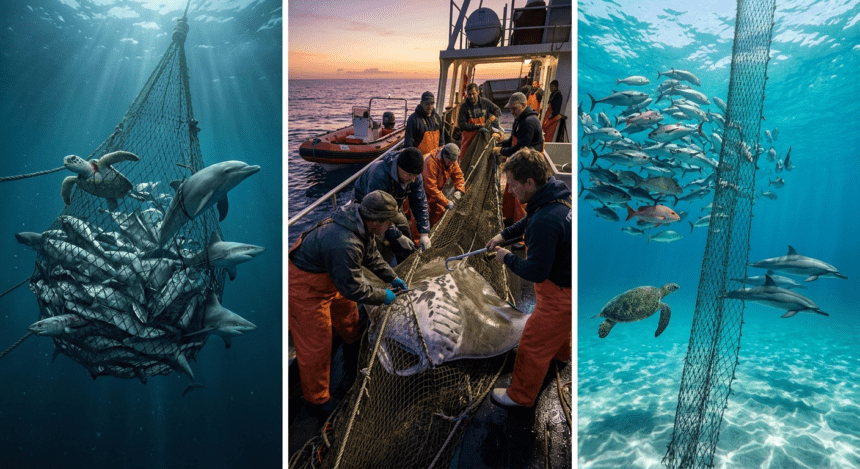
Every day, thousands of dolphins, sea turtles, and sharks don’t die from targeted hunting. They die because they were in the wrong place when a commercial fishing vessel dropped its gear. This is bycatch—the unintended capture of non-target species—and it’s currently the single biggest threat to marine megafauna globally.
Industrial fishing fleets cast millions of miles of gillnets and longlines into the oceans annually. These gear types act as indiscriminate walls. A turtle caught in a gillnet doesn’t stand a chance; it suffocates before the net is even hauled to the surface. For the fishing industry, these animals are just “discarded biomass.” For the ocean’s ecosystem, the loss is catastrophic.
The scale of the carnage is difficult to track, largely because most of it happens out of sight, deep in international waters. Conservation groups estimate that at least 300,000 whales, dolphins, and porpoises die in these nets every year. That’s roughly one every two minutes.
Technological fixes exist, but adoption remains sluggish. LED lights attached to gillnets have shown promise in deterring sea turtles, while “circle hooks” on longlines allow turtles to escape more easily than standard “J” hooks. The problem isn’t a lack of tools; it’s a lack of enforcement. Many vessels operate in regions where maritime oversight is non-existent, and the cost of retrofitting gear often falls on small-scale fishers who can’t afford the equipment.
The industry often points to “sustainable” labeling as a solution, yet investigative reports frequently find high rates of bycatch even within certified fisheries. Consumers see a blue checkmark on a package of tuna and assume the catch was clean. Reality is rarely that simple. A label doesn’t stop a shark from snagging on a hook meant for swordfish.
Some regions are taking drastic measures. The Mexican government, under intense pressure from international bodies, has implemented total bans on gillnet fishing in specific zones to save the vaquita—a rare porpoise now on the brink of extinction. With fewer than 10 individuals left in the wild, the ban is a desperate, last-ditch effort to stop the nets from finishing off the species.
Until global maritime regulations shift from voluntary guidelines to mandatory, monitored gear standards, the nets will keep killing. The ocean is running out of time to absorb the losses, and the current rate of bycatch is a debt that the marine ecosystem can no longer afford to pay.