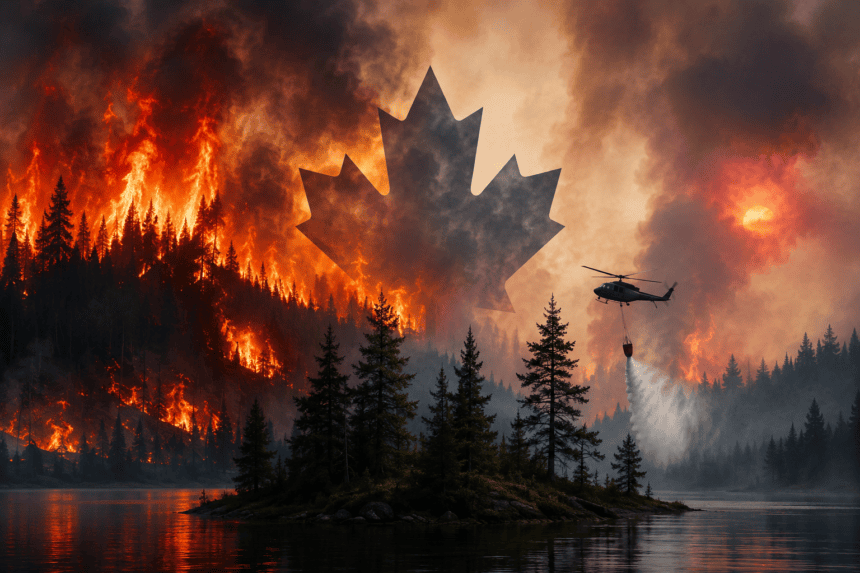
The smoke didn’t just hang over Canadian forests this year; it choked cities thousands of miles away. As the fire season winds down, the damage is no longer just a projection—it is a record-breaking reality. More than 15 million hectares of land have burned across Canada in 2024, eclipsing previous records and stretching firefighting resources to their absolute limit.
For many, the reality of the crisis hit when air quality alerts turned skies orange in New York, Chicago, and as far away as Europe. This wasn’t just a local emergency for remote northern communities; it was a continental health event.
Federal and provincial officials are now facing intense scrutiny over their preparedness. The sheer scale of the blazes forced the Canadian Armed Forces to deploy personnel to assist in remote regions, a move that is becoming an annual necessity rather than an outlier. “We are fighting fires that move faster than we can track,” one veteran forest technician told local media, noting that the intensity of these burns is leaving behind “moonscapes” where regrowth may take decades.
The financial toll is mounting alongside the environmental cost. Insurance adjusters are still tallying the damage to homes and critical infrastructure, but the bill is already expected to reach billions of dollars. Beyond the immediate property loss, the forestry sector—a cornerstone of the Canadian economy—is reeling from the loss of millions of cubic meters of timber.
Data from the Canadian Interagency Forest Fire Centre confirms that while the number of individual fire starts wasn’t uniquely high, the *intensity* and *size* of the fires were. Warmer, drier winters left the forest floor primed for ignition. A single lightning strike in a drought-stricken region can now trigger a blaze that burns for weeks, consuming hundreds of thousands of hectares before crews can even establish a perimeter.
Critics argue that the current wildfire management model is outdated. The focus has historically been on aggressive suppression, but experts are now calling for a shift toward controlled burns and better forest management to reduce fuel loads. The federal government has promised increased funding for satellite monitoring and rapid-response aerial assets, but critics say this is a reactive measure to a systemic climate problem.
As the smoke clears, the conversation has shifted from emergency response to long-term adaptation. Communities in the path of these fires are no longer asking if they will be evacuated, but when. For millions of Canadians, living with the threat of fire has become the new, grim status quo.