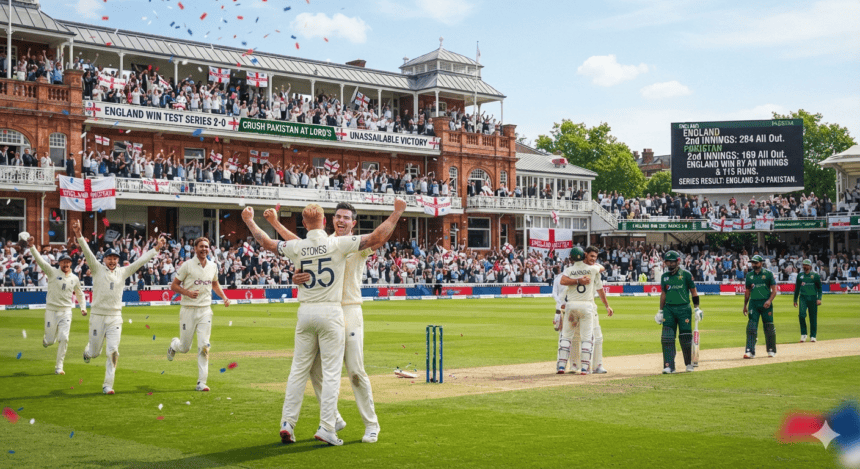
LONDON — England’s clinical efficiency proved too much for Pakistan at Lord’s on Sunday, as the hosts romped to a series-clinching victory. The seven-wicket win gives England an unassailable 2-0 lead, leaving Pakistan to reflect on a collapse that mirrored their struggles throughout the summer.
The writing was on the wall by mid-morning. Pakistan, resuming their second innings with a fragile lead, crumbled against a relentless English pace attack. The visitors were bundled out for just 165, handing England a target that never looked like a challenge.
Joe Root and Harry Brook steered the chase with typical composure. By the time the winning runs were struck, the result felt less like a contest and more like a formality. For Pakistan, the loss marks another low point in a year defined by inconsistency and tactical confusion.
The pitch at Lord’s offered little for the bowlers, yet England’s attack found movement where Pakistan’s could not. James Anderson and Ollie Robinson hit their lengths early, forcing the Pakistani top order into a defensive shell. Once the pressure mounted, the wickets followed in clusters.
“We didn’t adapt to the conditions,” Pakistan’s captain admitted in the post-match briefing. He spoke for less than two minutes, his frustration palpable as he side-stepped questions regarding the team’s recurring batting failures.
For the English camp, the series win validates a aggressive approach that has polarized traditionalists but delivered results on the scoreboard. They didn’t just outplay Pakistan; they out-thought them. Every bowling change felt calculated, every field placement designed to bait a mistake.
Pakistan’s dressing room now faces an uncomfortable week of introspection. With the third Test looming, the margin for error has evaporated. They have the talent, but at Lord’s, they lacked the temperament.
England heads to the final match with the trophy already secured. Pakistan heads to the airport with a series defeat and a mounting list of questions that the coaching staff has yet to answer.