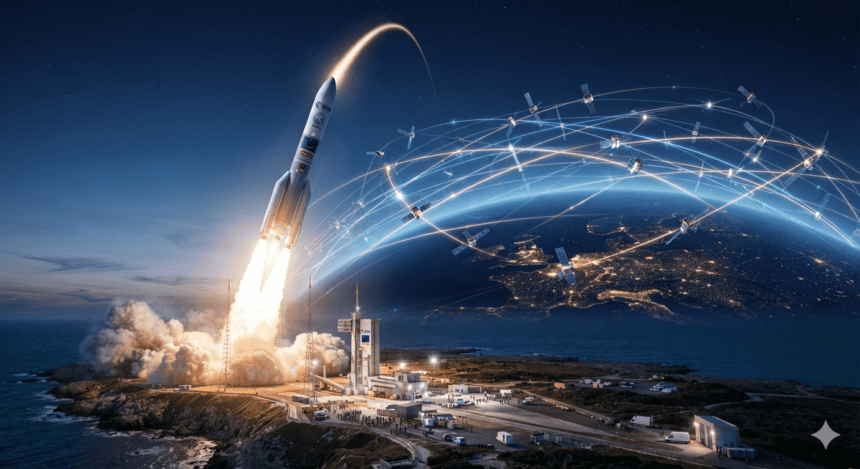
Europe is scrambling to overhaul its launch sector, aiming to slash wait times for satellite deployment as commercial demand reaches a fever pitch. The European Space Agency (ESA) and private partners are moving away from reliance on legacy rockets, shifting toward a more agile, competitive landscape to prevent the continent from falling behind the United States and China.
The pressure stems from a simple reality: Europe’s current launch capacity is insufficient. With the delayed debut of the Ariane 6 and the retirement of the Ariane 5, the region effectively lost its independent access to orbit for months. This vacuum forced European companies to book flights on SpaceX’s Falcon 9, a move that stings for an industry built on the principle of strategic autonomy.
ESA Director General Josef Aschbacher has been blunt about the stakes. He’s pushing for a “commercial-first” approach, urging member states to stop viewing space as a purely institutional project. The goal is to stimulate a market where European launch providers—like Germany’s Isar Aerospace or France’s MaiaSpace—can compete on cost and frequency.
Government officials in Brussels are now debating a “European Launch Services” model. It’s a shift that mirrors the NASA-contracted model across the Atlantic. By guaranteeing a baseline of government payloads, the EU hopes to give private startups the financial runway needed to scale up.
The backlog isn’t just about prestige; it’s about money. Every week a satellite sits in a cleanroom, it loses potential revenue. Startups are currently facing wait times that threaten their venture capital funding. If these companies can’t reach orbit, they can’t prove their technology, and they can’t sign the service contracts that keep them afloat.
Critics argue that European bureaucracy remains the biggest hurdle. Launching a rocket from French Guiana requires navigating a thicket of safety, environmental, and regulatory hurdles that don’t exist at the same scale in Texas or the Mojave Desert. Streamlining these processes is the next political battleground.
For now, the focus remains on the Ariane 6’s performance. Its successful inaugural flight in July provided a much-needed morale boost, but one launch isn’t a strategy. To truly compete, Europe needs a cadence that matches the industry’s hunger for orbit — or it risks becoming a permanent passenger on foreign rockets.