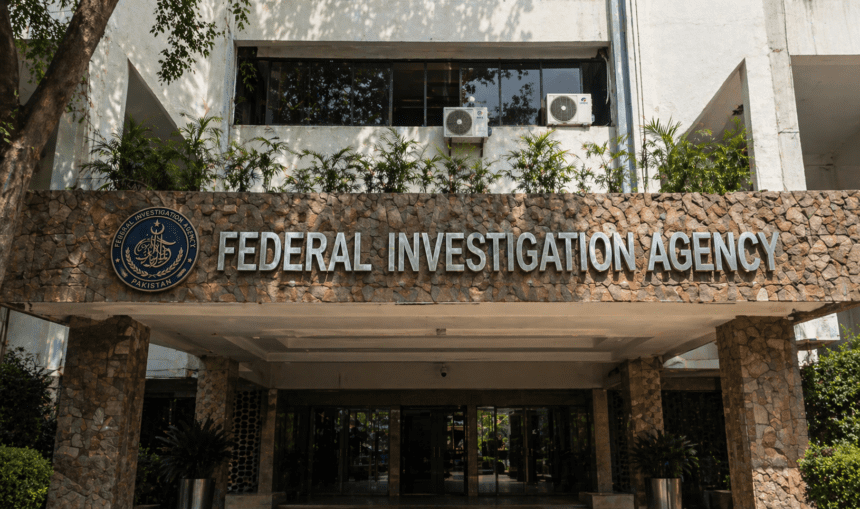
Pakistan’s Federal Investigation Agency appears to be moving to speed up money-laundering investigations, a shift that would put quicker case processing and closer scrutiny of suspicious financial trails at the center of its enforcement work. The push comes as the agency is already handling a string of active financial-crime matters, including a widened inquiry into alleged laundering in the media sector and other ongoing cases tied to suspicious bank transactions and overseas transfers.
The broader signal is clear enough: the FIA is under pressure to show that anti-money-laundering enforcement is not just alive, but moving. In recent years, the agency built out dedicated anti-money-laundering circles in multiple cities to strengthen investigations into money laundering and terror financing. That structure was presented as part of Pakistan’s effort to tighten enforcement and align with international expectations on illicit-finance controls.
At the legal level, the FIA already has the Anti-Money Laundering Act, 2010, listed among the core laws under which it operates. So any move to “fast track” probes would not mean creating a new legal framework from scratch. More likely, it points to quicker internal processing, tighter follow-up on inquiries, and faster conversion of intelligence into formal investigations and challans where evidence holds up. That is an inference based on the FIA’s existing mandate and the way recent cases have unfolded.
The timing matters. Only weeks ago, a banking court was told that the FIA had widened the prohibited foreign funding case involving PTI and was preparing to submit its challan. Separately, courts have continued hearing money-laundering matters linked to high-profile individuals, including a case involving Dr Fazeela Abbasi in which investigators traced large sums through multiple accounts and alleged transfers abroad. Those proceedings suggest the agency is not just opening inquiries; it is also trying to push them deeper into the prosecution stage.
There is also a practical reason the FIA may want faster outcomes. Money-laundering cases are notoriously slow, often involving bank records, shell entities, cross-border transfers and coordination with multiple institutions. Delays can weaken prosecutions, muddy evidence trails and give suspects room to move assets. International watchdogs have long stressed that countries need not only laws on paper, but effective enforcement that can trace and act on illicit proceeds before they disappear into more complex channels.
For Pakistan, that issue carries extra weight because anti-money-laundering performance has long been watched closely by global standard-setters. The FATF says its role is to lead global action against money laundering, terrorist financing and proliferation financing, and Pakistan’s own enforcement agencies have repeatedly framed stronger AML work as part of sustaining compliance and credibility. In plain terms, faster FIA probes would be read not just as a domestic law-enforcement step, but as a signal to regulators, lenders and international partners that financial-crime cases are being handled with more urgency.
What remains to be seen is whether “fast track” turns into real results. Announcing urgency is the easy part. The harder bit is building cases that survive in court, especially when they involve politically exposed people, complex business networks or alleged overseas assets. Even so, the recent pattern of expanded inquiries, court activity and specialised AML structures suggests the FIA is trying to show momentum at a time when every delay in a financial-crime case draws scrutiny.