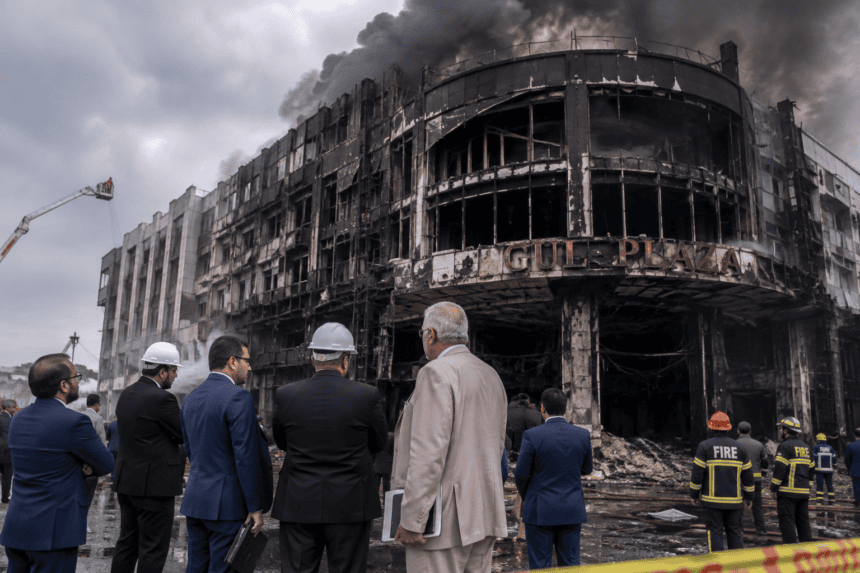
The Joint Committee (JC) investigating the devastating fire at Karachi’s Gul Plaza has pinned the blame squarely on the building’s management, citing a deliberate failure to address known structural and safety hazards.
The report, finalized this week, confirms that the shopping center’s administration was fully aware of the building’s non-compliance with fire safety protocols. Despite internal warnings and blatant electrical vulnerabilities, the management did nothing to upgrade the facility or mitigate the risks that eventually fueled the inferno.
Investigators found that the building’s fire suppression system was essentially decorative. Hydrants were dry, fire extinguishers had long expired, and emergency exits were routinely blocked by storage or unauthorized commercial partitions. These weren’t minor oversights; they were systemic failures that turned a standard electrical fault into a catastrophe.
The committee’s findings highlight a recurring pattern in Karachi’s commercial districts: building owners prioritize occupancy and floor space over the basic safety of shoppers and staff. By failing to maintain a functional alarm system or clear evacuation routes, the management effectively left the building’s thousands of daily visitors with no path to safety once the smoke filled the halls.
“The management chose to ignore every red flag,” a source familiar with the investigation said. They noted that documentation recovered during the probe shows that maintenance requests regarding faulty wiring were repeatedly shelved in favor of keeping stalls operational.
Legal experts now point to the report as a potential roadmap for criminal negligence charges. Under current building codes, the responsibility for fire safety falls squarely on the owners’ shoulders. With this official documentation in hand, the Sindh Building Control Authority (SBCA) faces mounting pressure to not only penalize the Gul Plaza management but to launch a wider audit of similar high-risk structures across the city.
For the shopkeepers who lost their livelihoods, the JC report offers little immediate relief. It confirms their worst fears: the destruction wasn’t an act of fate, but a direct result of management’s negligence. As the city waits to see if the authorities will actually prosecute those named in the report, the charred remains of the plaza stand as a stark reminder of the cost of cutting corners.