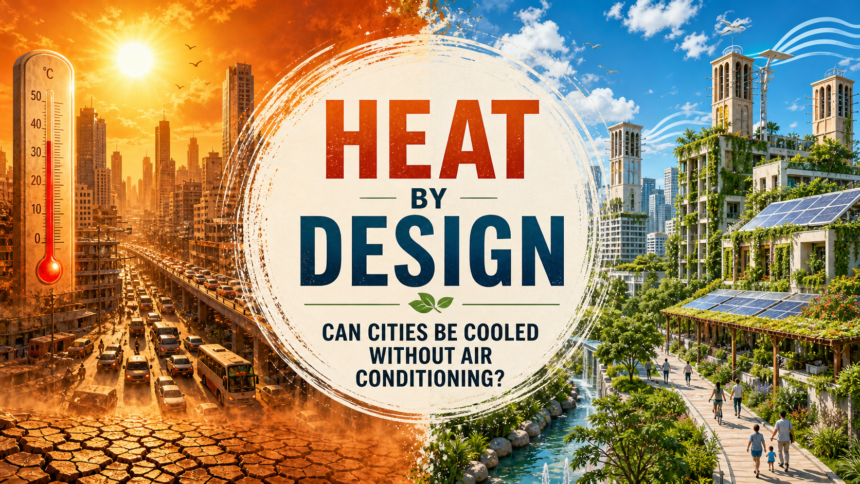
That is the honest answer emerging from the latest research on urban heat. Cities can be made meaningfully cooler without leaning only on air conditioning, especially through better street design, more shade, reflective roofs and pavements, improved ventilation, greener public spaces and buildings designed to block or release heat naturally. A recent meta-analysis of 373 studies found that nature-based solutions reduced daytime urban temperatures during hot periods by about 2.04°C on average. The World Bank has also framed passive measures as a core part of “cool cities” planning, not a side issue.
That matters because air conditioning, for all its life-saving value, is a difficult foundation for heat resilience on its own. It raises electricity demand, adds cost for households, can worsen inequity where poorer residents cannot afford enough cooling, and in many places dumps waste heat back into already overheated streets. UNEP’s latest cooling report argues that sustainable cooling has to rely much more heavily on passive, low-energy and hybrid approaches, rather than simply multiplying conventional AC use.
So what actually cools a city?
Start with shade. Trees, parks, green corridors and shaded streets do more than beautify neighborhoods; they lower surface and air temperatures, protect pedestrians and reduce the amount of solar heat absorbed by concrete and asphalt. The evidence for this is now pretty strong, and it is one reason nature-based solutions keep rising in urban policy debates.
Then there are the surfaces themselves. Dark roofs, roads and walls absorb heat all day and release it back slowly, keeping cities hot long after sunset. Reflective or “cool” roofs, lighter pavements and other solar-reflective materials help reduce that heat storage. The World Bank’s cool cities guidance treats these surface changes as practical tools cities can deploy at scale, especially where land for new greenery is limited.
Urban form matters too. Dense districts are not automatically bad, but badly designed density can trap heat and block airflow. Street orientation, spacing between buildings, ventilation corridors and the placement of public space all affect whether a neighborhood breathes or bakes. UN-Habitat’s latest cities report places urban planning and design at the center of climate action, which is really another way of saying that heat is not only a weather issue — it is a design issue.
Buildings themselves can also do far more before AC ever switches on. Passive cooling includes shading windows, insulating roofs, using reflective finishes, promoting cross-ventilation, reducing indoor heat gain and designing structures to work with local climate rather than against it. UNEP’s current guidance puts these passive and low-energy measures at the heart of a broader sustainable cooling pathway.
But there is a limit to how far design alone can go. During extreme heat, especially in dense low-income neighborhoods, informal settlements, hospitals, care homes and badly insulated housing, air conditioning or other active cooling may still be necessary to save lives. The real goal is not a fantasy city with no cooling systems at all. It is a city that needs less energy-intensive cooling, exposes fewer people to deadly heat, and uses mechanical cooling more selectively and safely. That is the direction the latest global guidance points toward.
There is another complication: who benefits first. Cooling by design can become unfair if wealthier districts get shaded boulevards, better materials and retrofitted buildings while poorer residents remain stuck in heat-trapping neighborhoods. UN-Habitat has warned that climate action in cities can become exclusionary if vulnerable communities are not built into the design from the start. That warning applies directly to urban heat policy.
So, can cities be cooled without air conditioning? Up to a point, yes. Quite a lot, actually. Streets can be shaded, roofs can reflect heat, neighborhoods can be ventilated better, and buildings can be designed to stay cooler naturally. But in a hotter world, especially one marked by inequality, the smarter question is not whether cities can do without AC altogether. It is whether they can be designed so that air conditioning becomes the backup, not the whole strategy.