By using this site, you agree to the Privacy Policy and Terms of Use.
Accept
Media HydeMedia Hyde
  • Home
  • Politics
  • Education
  • Entertainment
  • Sports
  • Blogs
  • Business & Commerce
  • Others
    • Religious
    • Metropolitan
    • Climate and Weather
Font ResizerAa
Media HydeMedia Hyde
Font ResizerAa
  • Home
  • Politics
  • Education
  • Entertainment
  • Sports
  • Blogs
  • Business & Commerce
  • Others
    • Religious
    • Metropolitan
    • Climate and Weather
Follow US
© 2026 Media Hyde Network. All Rights Reserved.
Climate and WeatherHeadline

How the Harappan Civilization Ended: The Mystery Behind the Decline of One of the World’s Earliest Urban Societies

Last updated: June 18, 2026 5:39 pm
Ayesha Masood
Share
How the Harappan Civilization Ended: The Mystery Behind the Decline of One of the World's Earliest Urban Societies
SHARE

The Harappan Civilization, also known as the Indus Valley Civilization, was one of the world’s earliest and most advanced urban societies. Flourishing between approximately 2600 BCE and 1900 BCE, it stretched across present-day Pakistan and parts of northwestern India, with major cities including Harappa, Mohenjo-daro, Dholavira, and Ganeriwala.

Known for its remarkable town planning, sophisticated drainage systems, standardized weights and measures, and extensive trade networks, the civilization represented a major achievement of the ancient world. However, despite its success, the Harappan Civilization gradually declined and eventually disappeared as a major urban culture.

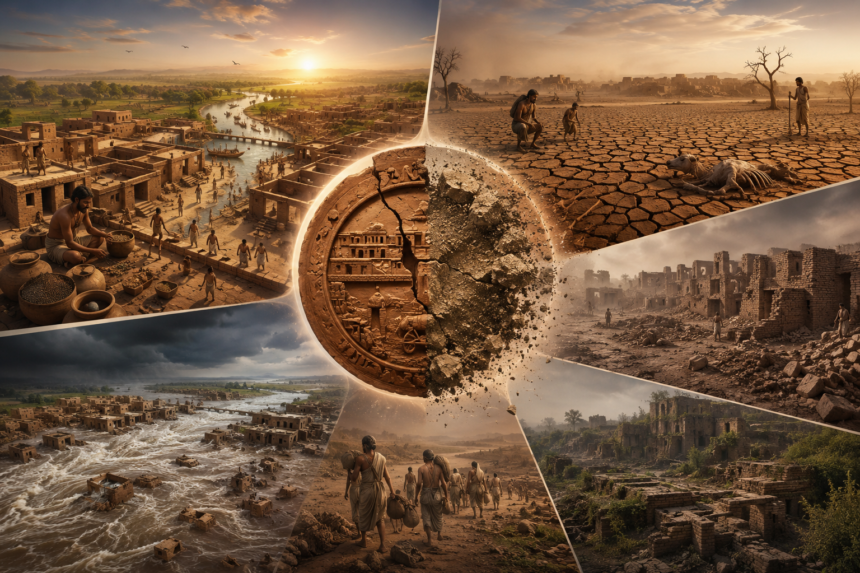
Historians and archaeologists generally agree that the civilization did not collapse because of a single catastrophic event. Instead, a combination of environmental, economic, and social factors likely contributed to its decline over several centuries.

One of the leading theories points to climate change. Scientific studies suggest that monsoon rains became weaker over time, resulting in reduced water availability for agriculture. Since farming formed the backbone of the Harappan economy, declining crop yields may have placed significant pressure on urban populations.

Another important factor was the changing course of rivers. Many Harappan settlements were established near rivers that provided water for farming, transportation, and daily life. Geological changes may have caused some rivers to shift course or dry up, disrupting agricultural production and forcing communities to relocate.

Trade also appears to have played a role in the civilization’s decline. The Harappans maintained commercial links with distant regions, including Mesopotamia. As environmental pressures increased and trade routes weakened, economic activity may have slowed, reducing prosperity in major urban centers.

Archaeological evidence indicates that large cities gradually lost population rather than being destroyed suddenly. Many people appear to have migrated from major urban centers to smaller villages and rural settlements where resources were more accessible. This suggests a slow transformation rather than an abrupt collapse.

Earlier theories proposed that foreign invasions were responsible for the downfall of the civilization. However, most modern researchers consider this explanation unlikely due to the lack of widespread evidence of warfare, destruction, or military conquest.

Experts now believe that the decline of the Harappan Civilization was a long-term process driven by environmental changes, economic challenges, and population movements. While the great cities eventually faded, many cultural traditions, agricultural practices, and technological innovations continued to influence later societies in South Asia.

Today, the mystery surrounding the decline of the Harappan Civilization remains one of archaeology’s most intriguing questions, with researchers continuing to study ancient climate patterns, settlements, and artifacts in search of definitive answers.


Share This Article
Email Copy Link Print
Previous Article Rs1 Billion Allocated for Sindh Infectious Diseases Hospital Karachi, Rs1.4 Billion for Pediatric Cardiology Unit at NICVD ‎
Leave a Comment

Leave a Reply Cancel reply

Your email address will not be published. Required fields are marked *

Sponsored Ads

Stay Connected

FacebookLike
XFollow
InstagramFollow
YoutubeSubscribe
WhatsAppFollow
ThreadsFollow
Rs1 Billion Allocated for Sindh Infectious Diseases Hospital Karachi, Rs1.4 Billion for Pediatric Cardiology Unit at NICVD ‎
Health
June 18, 2026
Karachi: Use of Expired Kits for HIV Testing Uncovered at Valika Hospital
Health
June 18, 2026
Valuable Medicines Worth Millions of Rupees Stolen from Lahore’s Mayo Hospital
Health
June 18, 2026
More Than 2,000 Transplant Patients Receive Free Treatment
Health
June 18, 2026
Why Outdoor Games Are Better Than Mobile Games for Kids
Blog Health
June 17, 2026
Why Your Muscles Twitch Suddenly Without Reason
Blog Health
June 17, 2026

You Might Also Like

Climate and Weather

Mexico Floods Kill at Least 27, Thousands Left Stranded as Torrential Rains Devastate Communities

By
Wajeeha Batool
Climate and Weather

Lahore Ranks Third Among World’s Most Polluted Cities

By
Wajeeha Batool
Climate and Weather

Longest Total Solar Eclipse of the Century to Occur in 2027

By
Wajeeha Batool
Why are gray whales dying in San Francisco’s waters? U.S. scientists search for clues
Climate and WeatherHeadline

Why are gray whales dying in San Francisco’s waters? U.S. scientists search for clues

By
Ayesha Masood
Media Hyde Media Hyde Dark
Facebook Twitter Youtube Rss Medium

About US

Media Hyde Network: Your instant connection to breaking stories and live updates. Stay informed with our real-time coverage across politics, tech, entertainment, and more. Your reliable source for 24/7 News.

Top Categories
  • Headline
  • Politics
  • Entertainment
  • Education
  • Sports
  • Religious
  • Metropolitan
  • Climate and Weather
Usefull Links
  • Contact Us
  • Disclaimer
  • Privacy Policy
  • Cookies Policy
  • Advertising Policy
  • Terms & Conditions

© 2025 Media Hyde Network. All Rights Reserved.

Welcome Back!

Sign in to your account

Username or Email Address
Password

Lost your password?