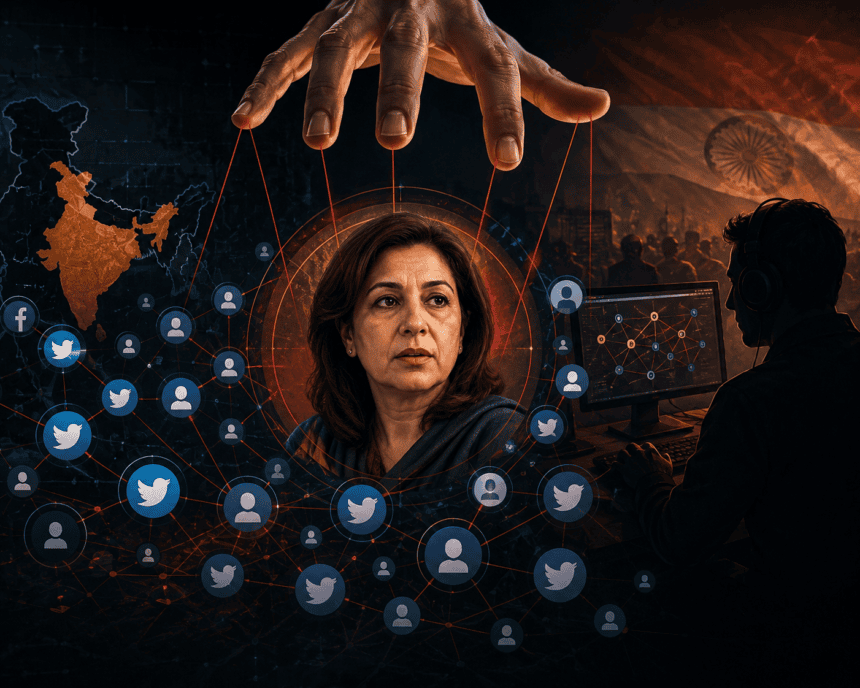
ISLAMABAD — Political analyst Huzaifa Rehman has accused Indian intelligence agencies of orchestrating a coordinated social media campaign to amplify controversial remarks made by Noreen Niazi, alleging a deliberate attempt to destabilize the domestic political narrative in Pakistan.
Rehman, speaking in a recent broadcast, claimed that the viral spread of Niazi’s statements was not organic. He pointed to metadata patterns and rapid cross-platform sharing originating from accounts linked to Indian cyber-influence operations. According to Rehman, the objective is to exploit internal fissures within Pakistani political discourse by pushing polarizing content to the forefront of trending topics.
The accusations center on the timing of the digital campaign. Rehman argued that the surge in engagement occurred precisely as local political tensions reached a boiling point, suggesting that external actors are monitoring Pakistan’s social media landscape to identify and weaponize divisive rhetoric.
“This isn’t just about one person’s opinion,” Rehman told his audience. “These networks identify the most inflammatory clips, inject them into our digital ecosystem, and wait for the backlash to tear the conversation apart.”
While Rehman did not provide granular technical logs, he cited a shift in how certain accounts—previously inactive or focused on regional geopolitical narratives—suddenly pivoted to domestic Pakistani feuds. He categorized this as a “fifth-generation warfare” tactic, designed to erode public trust in local institutions by creating a sense of perpetual, manufactured chaos.
Critics of the theory note that social media algorithms often prioritize high-emotion content regardless of its origin, making it difficult to distinguish between organic outrage and state-sponsored amplification. However, Rehman maintains that the scale and speed of the dissemination point toward automated bot networks rather than genuine user interest.
The controversy surrounding Niazi’s comments has already triggered a firestorm of debate across X (formerly Twitter) and Facebook, with various political factions trading barbs. As the digital shouting match continues, the focus has shifted from the content of the remarks to the authenticity of the discourse itself.
Whether these claims of foreign interference hold water or serve as a convenient deflection remains a point of contention. For now, the episode serves as a reminder of how easily the digital space can be manipulated, turning a single comment into a national security headache.