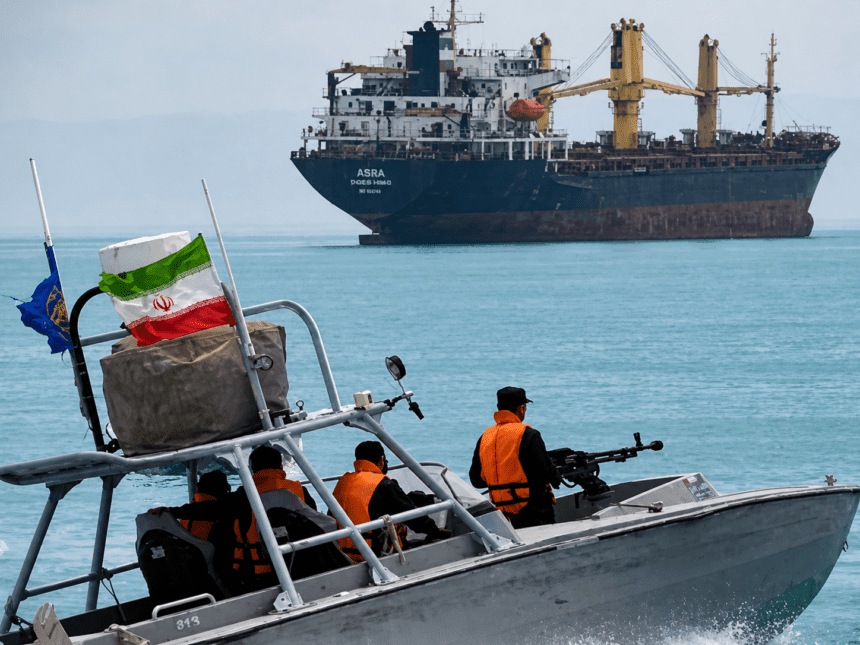
Iran has warned it will respond with force if U.S. military assets enter the Strait of Hormuz, sharply escalating tensions after President Donald Trump announced a new American-led effort to help guide stranded commercial ships through the waterway. The warning came as Washington launched “Project Freedom,” a mission the White House has framed as a humanitarian and maritime-security operation aimed at easing a shipping crisis that has dragged on even after a fragile ceasefire.
The Strait of Hormuz, one of the world’s most strategically important energy chokepoints, has become the latest flashpoint in the broader U.S.-Iran confrontation. Roughly one-fifth of global oil and gas trade normally moves through the passage, and the current disruption has rattled shipping markets, pushed up energy prices and left large numbers of vessels and seafarers stuck in or near the Gulf. Recent reporting from AP and the Washington Post says more than 2,000 vessels and around 20,000 seafarers have been affected by the standoff.
Trump said over the weekend that the United States would begin guiding ships from countries not involved in the war, with operations starting Monday, May 4. According to AP, the plan includes guided-missile destroyers, more than 100 aircraft and about 15,000 service members. On the first day of the effort, a U.S.-led maritime task force reportedly told ships to reroute through an “enhanced security area” south of the traditional shipping lanes because of the risk posed by possible undetected mines.
Tehran has cast that move as a direct challenge. Iranian officials have said any American military presence tied to managing or policing the strait would amount to interference and, in their view, a violation of the ceasefire terms. Coverage from multiple outlets on May 4 said Iran warned it would attack U.S. or other foreign military forces entering the strait, while insisting that control over traffic there cannot be dictated by Washington.
The confrontation is unfolding against an already dangerous maritime backdrop. A tanker and another vessel reported fresh attacks near the strait over the weekend, with British maritime monitoring cited by AP and Reuters saying one ship was hit by unknown projectiles while another reported an assault by multiple small craft. Those incidents added to a growing tally of attacks, suspicious approaches and hijackings recorded in and around the Arabian Gulf, the Strait of Hormuz and the Gulf of Oman since late February. UKMTO’s latest public summary said it had received 41 incident reports by May 2, including 23 attacks.
Washington has already increased its military footprint around the waterway in recent weeks. CENTCOM said in April that U.S. forces had begun mine-clearance operations in the Strait of Hormuz and separately announced a blockade on ships entering or exiting Iranian ports, while stating that freedom of navigation for vessels transiting to non-Iranian ports would not be impeded. Those earlier steps now appear to be feeding directly into the current escort mission.
Diplomacy, meanwhile, remains shaky. AP and other outlets report that Iran is reviewing a U.S. response to a 14-point Iranian proposal transmitted via Pakistan, while Washington has publicly maintained pressure and signaled that broader sanctions and military leverage remain on the table. So for now, the picture is messy: a ceasefire that hasn’t really settled the waterway, a U.S. operation expanding at sea, and an Iranian threat that leaves very little room for miscalculation.