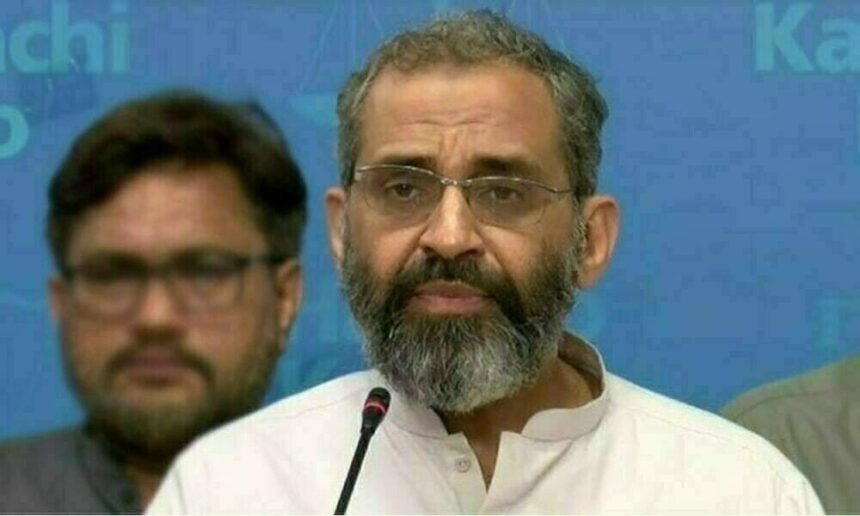
KARACHI: Jamaat-e-Islami (JI) Karachi Ameer Monem Zafar Khan has strongly criticized the government for what he termed as “systematic exploitation” of Karachi’s citizens and called on the public to stand up for their rights.
Addressing a press conference at the party’s city headquarters, Idara Noor-e-Haq, on Thursday, Monem Zafar condemned the traffic police’s heavy-handedness, accusing them of “aggressive” fining tactics while essential services remain neglected in Pakistan’s largest tax-paying city.
Citing official data, he revealed that over 52,000 traffic challans were issued in Karachi in just two months, questioning the government’s priorities and the traffic police’s approach. He also condemned the impounding of motorcycles, which he said are often the sole means of transport for low-income families.
He lashed out at Sindh’s Inspector General of Police for proposing stricter measures—such as doubling fines, suspending driving licenses, and blocking CNICs of those who fail to pay penalties. “What if someone can’t pay within 200 days—will you take away their citizenship?” he asked.
Monem accused authorities of applying harsh regulations only to Karachi, despite the city being denied basic civic amenities. “Where are the footpaths, zebra crossings, traffic signals? Why is the focus only on challans?” he asked, blaming the lack of infrastructure for growing public frustration, especially among the youth.
To support those affected by what he described as “traffic police excesses,” he announced that JI will establish help desks in all district offices to assist citizens facing unjust penalties.
He also advised motorcycle riders—numbering over 4.5 million in Karachi—to wear helmets, keep valid licenses, follow traffic laws, and resist corruption.
Highlighting Karachi’s tax contribution of Rs3,256 billion—a 29.46% increase over the previous year—Monem questioned why the city remains deprived of proportionate development. He particularly criticized the meager Rs3.2 billion allocation for the long-delayed K-IV water project, which now requires nearly Rs200 billion after ballooning from its original Rs26 billion estimate.
Taking aim at Karachi Mayor Murtaza Wahab, Monem questioned the effectiveness of the Karachi Water and Sewerage Corporation, especially in light of recent urban flooding. “If drainage is not their responsibility, then whose is it?” he asked, adding that the Sindh government received $1.6 billion in foreign aid for water and sanitation, yet conditions have barely improved.
On traffic woes, he called for an urgent investment in mass transit, proposing 10,000 new buses, a light rail system, and revival of the Karachi Circular Railway (KCR). “Only 300 buses have been added in 17 years—this is unacceptable for a city this size,” he said.
Responding to a question on JI’s development agenda, Monem emphasized that education, healthcare, and infrastructure remain top priorities. He noted that in the nine Karachi towns currently run by JI, budget allocations for these sectors have been increased. “We’re working to build a city where citizens are empowered and respected—not penalized.”