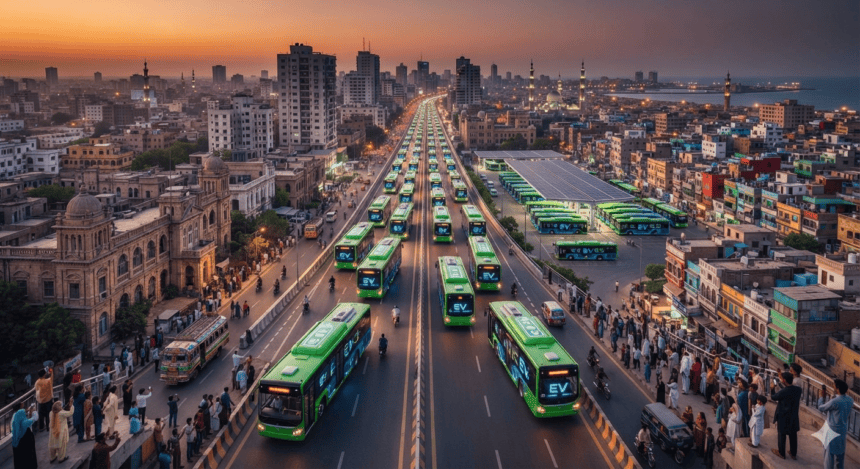
The Sindh government has finalized plans to induct 1,000 electric buses into Karachi’s public transport network. This move aims to overhaul the city’s aging transit infrastructure and cut down on the massive carbon footprint generated by thousands of smoke-belching minibuses.
Transport Minister Sharjeel Memon confirmed the procurement process is moving to the final stages. The project relies on a public-private partnership model, with the government providing the infrastructure while private operators manage daily operations.
Karachi’s commuters have spent decades relying on unreliable, privately-owned minibuses that often ignore safety standards. These new EV buses offer a stark contrast: air-conditioned cabins, designated seating, and, crucially, zero tailpipe emissions.
The immediate challenge remains the power grid. Officials are currently mapping out charging stations across the city, targeting high-traffic corridors like Shahrah-e-Faisal and the Korangi Industrial Area. Without a dedicated, consistent power supply, these buses risk sitting idle during the city’s frequent load-shedding cycles.
Finance experts point to the long-term savings. While the initial capital expenditure for electric vehicles is higher than diesel equivalents, the cost of electricity is expected to undercut fuel prices significantly. The provincial government is banking on these operational savings to keep ticket prices stable for the average passenger.
Opposition leaders have raised questions about the timeline. Similar announcements in the past have stalled due to bureaucratic delays and funding gaps. For a city of 20 million people, the success of this fleet depends entirely on whether the government can build the charging infrastructure faster than the buses arrive.
The first batch is expected to hit the streets within the next six months. If the rollout sticks to the schedule, it will mark the most significant modernization of Karachi’s transit since the launch of the Green Line BRT.
The real test, however, won’t be the arrival of the buses—it will be their maintenance. Karachi’s roads are notoriously unforgiving, and the city’s history is littered with broken-down, abandoned government projects. For now, the administration says they have locked in long-term maintenance contracts to ensure these vehicles don’t end up as roadside scrap.