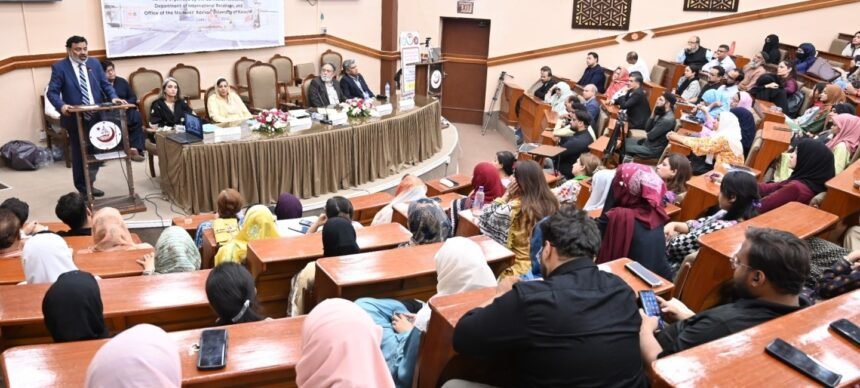
The Confucius Institute at the University of Karachi in collaboration with the KU’s International Department and Students’ Advisor Office arranged an important conference on the completion of 75 years of diplomatic relations between China and Pakistan and in connection with the Chinese Language Day. In this conference, academics, intellectuals, and policymakers held detailed discussions on regional connectivity, the China-Pakistan Economic Corridor, and the changing global landscape.
The title of the conference was “CPEC and Regional Connectivity from South Asia to Central Asia: Challenges and Opportunities”. The event was held at the KU’s Chinese Teachers Memorial Auditorium on Wednesday.
The Chairman of the Pakistan-China Institute located in Islamabad Mushahid Hussain Syed in his keynote online address, said that at different stages of history, global and regional circumstances have provided nations with countless opportunities to learn and improve themselves.
He said that Pakistan has always established strong and lasting relations with its friends, allies, and partners, and despite changes in the global system, relations with China have remained stable and durable.
He emphasized that Pak-China relations are a shining example of mutual trust, respect, and continuous cooperation, where both countries have stood by each other in every difficult time. He described Pakistan as the “Motherland of Friends,” saying that its relationships are nurtured based on stability, loyalty, and mutual respect.
Mushahid Hussain Syed stressed the importance of academic and intellectual dialogue, saying that, unlike the past, dialogue has become extremely important in today’s era, because this process provides the foundation for policymaking, mutual understanding, and positive progress at the global level. He further said that meaningful cooperation between universities and research institutions can have positive effects not only regionally but also globally.
Referring to the global technological race between China and the United States, he said that China is rapidly emerging as a scientific superpower. According to him, about 40 percent of research papers in the field of artificial intelligence are being published from China, while a significant number of the world’s leading scientific institutions are established in China, which indicates a major shift in the global intellectual balance.
On this occasion, the KU Vice Chancellor Professor Dr Khalid Mahmood Iraqi said that the KU’s Confucius Institute has been playing an active role at the University of Karachi since 2013, which is not only strengthening Pakistan-China relations but also rendering significant services in promoting Chinese language and culture in Pakistan.
He said that China, as an emerging global power, has achieved a prominent position not only in economic development but also in the field of research and development. He emphasized that along with development, it is extremely necessary to preserve one’s culture and values, for which adopting a realistic strategy is indispensable.
The KU VC Professor Dr Khalid Iraqi described the Belt and Road Initiative as an example of a comprehensive concept of development, saying that CPEC is the practical manifestation of this vision, which is playing a key role in promoting regional connectivity, trade, and economic development.
Another online speaker, the Chinese Director of the KU’s Confucius Institute Professor Zhang Xiaoping said that this institute hasSet featured image become an important part of the University of Karachi, which is continuously contributing to improving educational standards, training students, and promoting intercultural connections. He said that 75 years of Pakistan-China friendship is a historic milestone, during which both countries have promoted joint development and strategic partnership.
He further said that the China-Pakistan Economic Corridor has made significant progress in the fields of infrastructure, energy, trade, and legal reforms in the region, strengthening connectivity between South Asia and Central Asia.
The Pakistani Director of the KU’s Confucius Institute Professor Dr Nasruddin Khan said that the Chinese language is not merely a means of communication but a key to understanding a civilization, history, and thought. He said that about 1.3 billion people worldwide speak Chinese, which makes it an important global language.
He said that learning the Chinese language not only helps in understanding China’s development and its global role but also strengthens people-to-people connections between Pakistan and China, which is the foundation of lasting friendship.
The KU’s Dean of the Faculty of Arts and Social Sciences Professor Dr Samina Saeed said that CPEC is not merely a collection of development projects but a revolutionary vision of regional integration, which is connecting different regions together. She emphasized that it is the responsibility of the academic community to critically review these projects and fully benefit from new opportunities.
The KU’s Chairman of the Department of International Relations Professor Dr Naeem Ahmed said that after the end of the Cold War, many new challenges emerged in the global system, which compelled experts to formulate new theoretical frameworks. He said that the Belt and Road Initiative and CPEC have created new possibilities for regional cooperation, however, ongoing conflicts in the region are also challenges for these projects.
Referring to the complex strategic situation of the region, he said that tensions among major regional powers and recent global conflicts have further increased security concerns, which can also affect regional development.
At the conclusion of the conference, KU’s Students’ Advisor Dr Nosheen Raza expressed that such academic sessions not only promote dialogue but also pave the way for better policymaking and regional cooperation in the future.