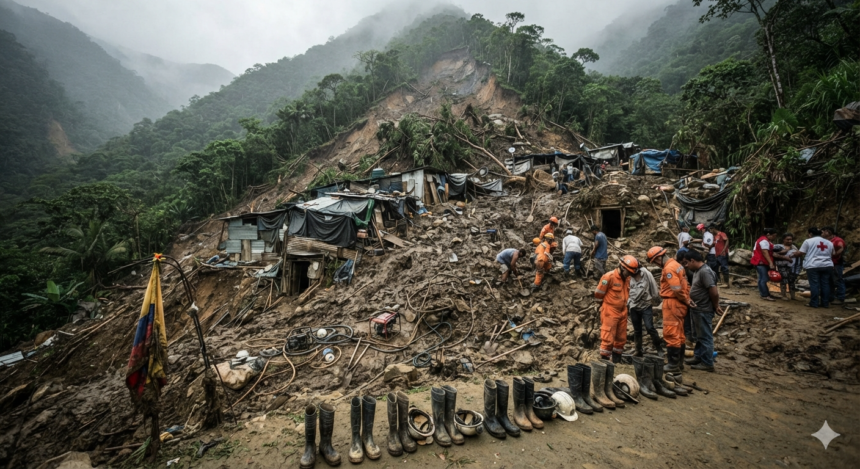
A landslide triggered by heavy rainfall buried an illegal gold mine in the Cauca department of Colombia on Tuesday, leaving at least 13 miners dead. The collapse occurred in the municipality of Santander de Quilichao, a region where informal mining operations have long operated outside the reach of government safety regulations.
Search and rescue teams spent hours digging through mud and debris in the remote area. By Wednesday morning, emergency responders confirmed the recovery of 13 bodies. Local officials believe the death toll could rise as families continue to report missing relatives who were working in the pit when the hillside gave way.
The site was a makeshift operation, lacking the structural reinforcements required for deep-earth excavation. Heavy rains in the region had saturated the soil, turning the hillside above the mine into a death trap.
“These people were working in conditions that were essentially a gamble with their lives,” said a local emergency coordinator involved in the recovery efforts. “There is no oversight, no emergency protocols, and no way to stabilize a slope like that once the rains start.”
Illegal mining remains a persistent crisis across Colombia. Thousands of residents in impoverished areas turn to unregulated gold extraction as their primary income, often unaware or indifferent to the lethal risks. While the government frequently promises crackdowns, these small-scale, clandestine pits often pop up overnight in areas where the state lacks a physical presence.
This incident marks one of the deadliest mining accidents in the region this year. For now, the focus remains on clearing the site to ensure no other victims remain trapped under the slurry.
Beyond the immediate search, the tragedy leaves a community grappling with the loss of its breadwinners—a grim reminder of the human cost of an industry that operates entirely in the shadows.