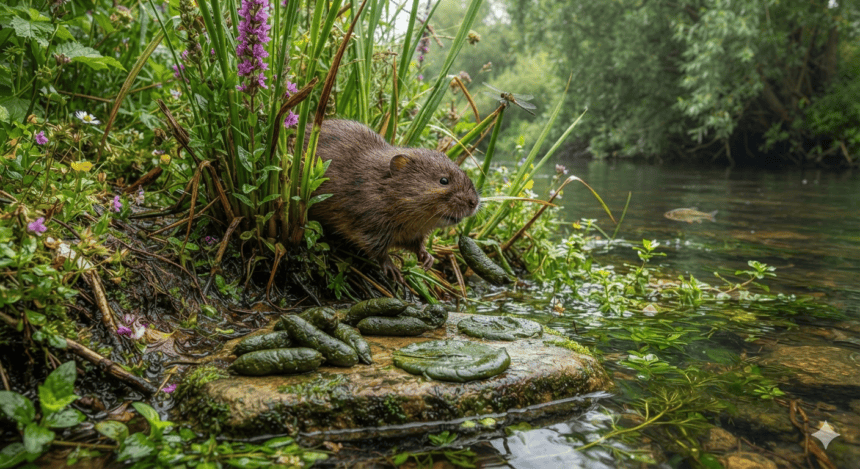
Water voles are making a comeback in Britain’s waterways, and the proof is sitting in piles of flattened droppings along the riverbanks. Conservationists tracking these elusive mammals rely on “latrines”—specific sites where voles repeatedly deposit their waste—to gauge population health.
The presence of these characteristic, squashed droppings indicates more than just biological activity. It signals that water voles are successfully establishing territories and breeding in areas where they were once locally extinct.
For decades, the species faced a catastrophic decline. Habitat loss, coupled with the spread of invasive American mink, decimated their numbers. In some regions, populations plummeted by over 90% during the late 20th century. Seeing fresh latrines today offers the first concrete evidence that reintroduction programs and mink-control efforts are actually moving the needle.
“It’s the best non-invasive metric we have,” says Dr. Elena Thorne, a field ecologist specializing in wetland biodiversity. “When we find these flattened, cigar-shaped droppings in clusters, we know we aren’t just looking at a passing individual. We’re looking at a stable, territorial colony.”
The science of the “squash” is simple. Water voles are fastidious about their latrines. They use these spots to communicate with rivals and potential mates, often trampling the droppings into the mud or vegetation as they move across the site. A single, scattered dropping might be a fluke; a dense, trampled latrine is a sign of a thriving community.
While the return of the water vole is a win for wetland health, the recovery remains fragile. Mink populations, though managed in many areas, still pose a constant threat. Furthermore, the degradation of riverbanks—often due to intensive farming or urban development—continues to restrict the corridors these animals need to expand their range.
Conservation groups are now using this data to map “hotspots” for protection. By identifying where these latrines are most concentrated, they can target habitat restoration efforts, such as planting specific grasses that voles favor for food and cover.
Water voles remain one of Britain’s most endangered mammals, but the evidence left in the mud tells a story of persistence. They are reclaiming their territory, one latrine at a time.