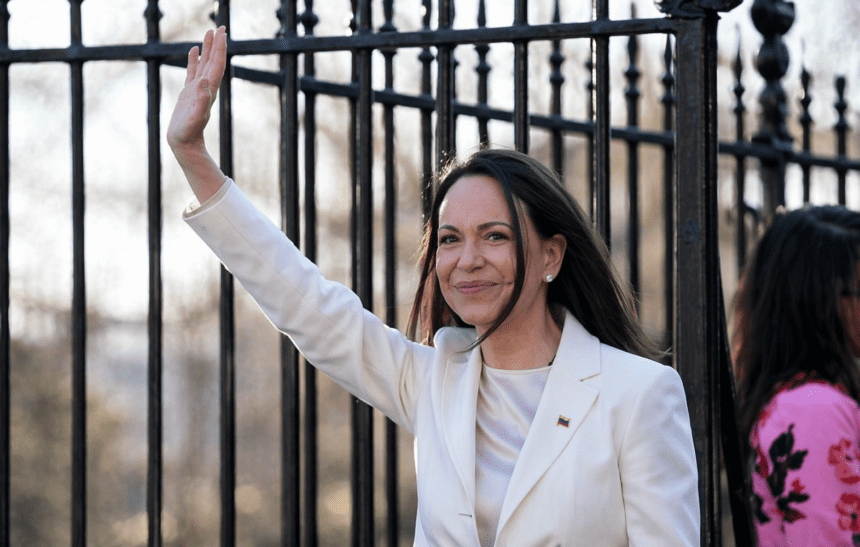
Venezuelan opposition leader María Corina Machado said on Saturday she has “no regrets” about symbolically handing over her Nobel Peace Prize to U.S. President Donald Trump in January, doubling down on a gesture that drew immediate international attention and fresh criticism at home and abroad. The remark lands at a delicate moment for Venezuela, where Machado remains one of the most recognizable faces of the anti-Maduro movement, but where the path back to a democratic transition still looks murky.
The prize itself is not in doubt. Machado was awarded the 2025 Nobel Peace Prize for what the Norwegian Nobel Committee described as her “tireless work promoting democratic rights” in Venezuela and her push for a peaceful transition away from dictatorship. That made the January episode all the more unusual: Machado publicly framed her gesture toward Trump as recognition for his role in Venezuela’s political crisis, while the Nobel Foundation moved quickly to stress that a Peace Prize cannot be revoked, shared or transferred once awarded.
That tension — between symbolism and formal reality — has shadowed Machado ever since. In January, after meeting Trump at the White House, she said she had presented the medal to him as a thank-you for what she called his commitment to Venezuelan freedom. Trump welcomed the gesture, but the Norwegian Nobel Institute made clear that whatever happens to the medal itself, the laureate remains Machado and Machado alone. In other words, the politics could be dramatic, but the record books were never going to change.
The episode also exposed a harder truth about Machado’s position. Even while praising her personally, Trump signaled in January that he was not fully sold on her ability to lead Venezuela’s transition, and U.S. officials stopped short of backing any concrete electoral roadmap tied to her return. AP reporting at the time described a deeply awkward political split: Machado was trying to thank Washington for its role, yet Washington itself was sending mixed messages about who should steer post-Maduro Venezuela.
That matters because Machado’s political authority has long rested on more than headlines. She won Venezuela’s opposition primary in 2023, but authorities barred her from running in the 2024 presidential election through a 15-year disqualification that rights groups and critics of Nicolás Maduro saw as part of a broader effort to choke off meaningful competition. Human Rights Watch said Venezuela made little progress on electoral reforms ahead of the 2024 vote, while AP reported that Machado ultimately had to campaign as the driving force behind replacement opposition candidate Edmundo González Urrutia.
The 2024 election remains central to why Machado still carries so much symbolic weight. AP reported strong evidence that González, the opposition’s stand-in candidate, won the July 28 vote by nearly a 2-to-1 margin even though Maduro was declared the winner. That dispute helped turn Machado into something larger than a conventional party leader: part organizer, part witness, part political survivor. So when she says she has no regrets about the Nobel gesture, she is not just defending a personal decision. She is defending a strategy — one rooted in the belief that international pressure, especially from Washington, remains essential to breaking Venezuela’s deadlock.
Still, the gamble is obvious. To supporters, Machado’s move toward Trump looked like blunt, transactional politics in a crisis — messy, maybe, but honest. To critics, it risked cheapening one of the world’s highest-profile peace awards while tying Venezuela’s democratic cause too tightly to an unpredictable U.S. president. The Nobel Foundation’s intervention did not settle that argument; it just clarified the legal part. The political argument is very much alive.
For now, Machado appears unwilling to retreat. Bloomberg reported on Saturday that she is in close talks with the United States over a possible return to Venezuela, though she gave no date. That makes her latest “no regrets” remark sound less like a throwaway line and more like a signal: she is still betting that visibility, outside backing and moral pressure can move a process that has repeatedly stalled. Whether that bet pays off is another question entirely. Venezuela has heard big promises before.