Seminar on Makkah Defence Pact, US-Iran War and Public Held at FUUAST
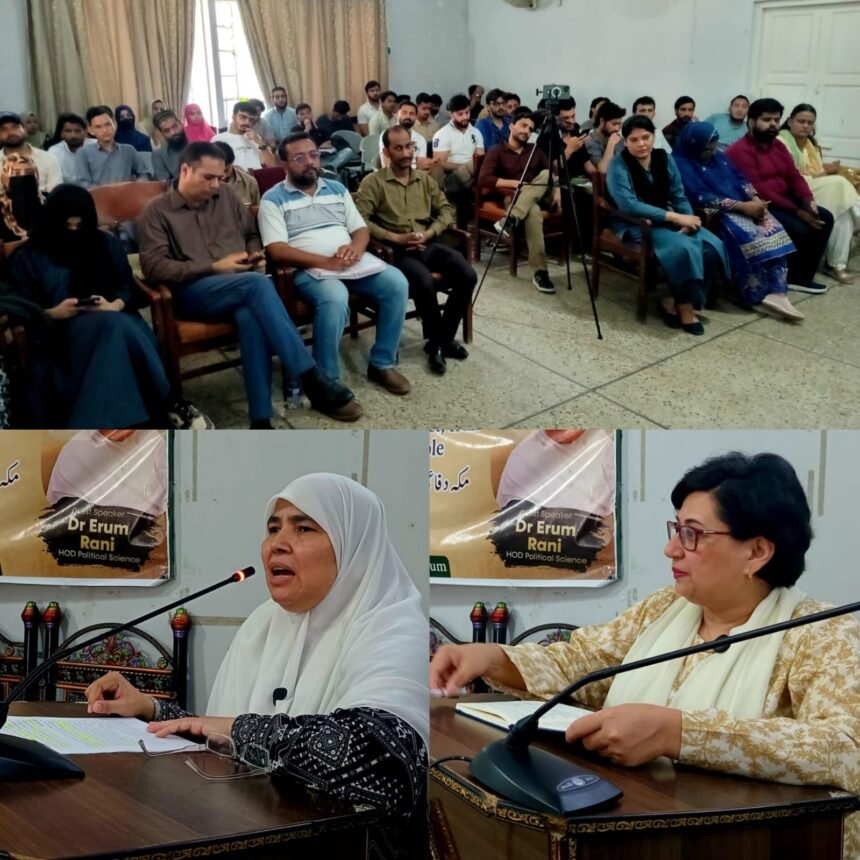
Karachi: A seminar titled “Makkah Defence Pact, US-Iran War and the Public” was organized by the Department of Mass Communication, Abdul Haq Campus, Federal Urdu University of Arts, Science and Technology (FUUAST). Senior journalist and analyst Manza Siddiqui and Head of the Department of Political Science Dr. Rani Aram addressed the seminar.
Speaking at the seminar, senior journalist and Executive Producer Manza Siddiqui said that war is not beneficial for any country or society. The consequences of war are not limited to the countries directly involved but also affect the entire region and the lives of ordinary people. She said that during wartime, the poor and middle classes are among the worst affected, as conflicts lead to inflation, unemployment and economic difficulties.
She said that any war or international conflict should not be viewed solely from a military perspective; its political, economic, social and humanitarian dimensions must also be examined. Referring to the Makkah Defence Pact, she said it was important for Pakistan to understand the economic and foreign-policy aspects of such regional agreements. According to her, Pakistan must make foreign-policy decisions while keeping its economy, public interests and regional relations in view.
Manza Siddiqui said that Pakistan’s participation in the Makkah Defence Pact and the designation of Islamabad as its secretariat were important developments from a foreign-policy perspective. However, she added that all aspects of any defence or regional agreement should be examined in order to understand its potential implications.
Speaking about the role of the media, she urged journalists to present verified information and facts while reporting and to avoid disseminating unverified information. She stated that before the US-Iran war, the Strait of Hormuz had become an important centre of global oil trade, where transactions were being conducted in local currencies among countries and a trading centre had emerged where the dollar did not enjoy the same prominence.
Head of the Department of Political Science Dr. Rani Aram said that all details of the Makkah Defence Pact were not yet clear; therefore, instead of reaching a final conclusion about its possible effects, it was necessary to wait for further information and developments.
She said that the political situation in the region was changing rapidly and that the effects of tensions between Iran and the United States would not remain confined to the two countries. She also said that the border dispute between Yemen and Saudi Arabia had existed for a long time and needed to be understood in its proper historical and political context.
Dr. Rani Aram said that the changing situation in the region was also affecting Pakistan. Geographically, Pakistan is an important country, and major developments in the region can have an impact on its foreign policy, economy and domestic situation. She urged students to study international politics, diplomacy and regional relations in order to understand the current global situation.
She said that decisions taken at the international level have direct effects on the lives of ordinary citizens. Wars and conflicts can affect the prices of essential commodities, trade, employment and other sectors. Therefore, public awareness of these issues is also essential.
Addressing the seminar, Head of the Department of Mass Communication Dr. Irfan Aziz said that the Makkah Defence Pact and the US-Iran war were important developments in the context of the current regional situation. He said that organizing such academic and informative seminars at the university helps students understand national, regional and international affairs.
He said that students of Mass Communication would join different fields of journalism and media in the future; therefore, it was essential for them to remain informed about international politics and the changing situation in the region. Dr. Irfan Aziz said that the fundamental purpose of journalism was to provide accurate information to the public and create awareness in society about important issues.
During the seminar, the speakers discussed the humanitarian and economic consequences of war, US-Iran tensions, the Makkah Defence Pact, Pakistan’s regional situation and the role of the media. Students also asked the speakers various questions concerning the impact of war on ordinary people, Pakistan’s economy, changing regional dynamics and the responsibilities of the media. The speakers responded to the questions and encouraged students to understand global affairs from different perspectives.
The seminar was attended by faculty members of the Department of Mass Communication, including Dr. Sharjeel Naveed, Dr. Huma Nisar, Zareen Akhtar, Ayaz Ahmed, Dr. Samreen and Dr. Nasir Mahmood, as well as members of the Nomination Committee Dr. Syed Iqbal Naqvi and Dr. Roshan Ali Soomro, Teachers’ Association Treasurer Khurram Shah Nawaz, Dr. Usman, and a large number of male and female students. Participants also asked questions from the experts at the conclusion of the seminar.
At the end of the seminar, Dr. Syed Iqbal Naqvi, member of the Nomination Committee and teachers’ representative, thanked the guest speakers, faculty members and students. He said that such academic programmes provide students with an opportunity not only to participate in educational activities but also to understand national, regional and global issues in a practical context.
Makkah Defence Pact, US-Iran War and the Public
Leave a Comment