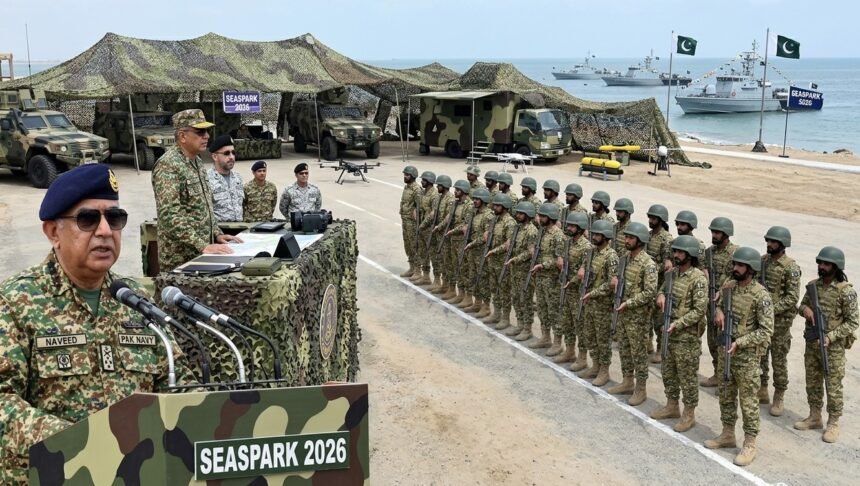
KARACHI, September 20, 2026: Chief of the Naval Staff Admiral Naveed Ashraf visited Pakistan Navy units deployed at sea and in the Creeks Area to review the ongoing Exercise SEASPARK-2026 and assess the operational preparedness of participating forces.
The biennial maritime exercise began on September 1 and is designed to rehearse the Pakistan Navy’s ability to conduct the full spectrum of maritime operations. According to the Inter-Services Public Relations (ISPR), the exercise is also testing the Navy’s ability to rapidly transition from peacetime activities to wartime operations when required.
SEASPARK-2026 incorporates several emerging dimensions of modern warfare. The exercise includes Operations in the Information Environment, Multi-Domain Operations and extensive use of unmanned systems, reflecting the growing importance of technology and information capabilities in contemporary military operations.
The exercise involves the integration of maritime capabilities with other operational domains. Earlier reports said the drills bring together ships, submarines, aircraft, unmanned systems, marines and special forces, alongside elements of the Pakistan Army and Pakistan Air Force. The exercise is intended to strengthen coordination and evaluate the effectiveness of joint operations across maritime, air, land, cyber and space-enabled domains.
During his visit, Admiral Naveed Ashraf interacted with personnel participating in the exercise and reviewed ongoing operational activities. He commended the participating personnel for their professionalism, high morale, operational readiness and determination to maintain a strong presence at sea.
The review comes amid heightened maritime activity in the region. Pakistan’s Foreign Office said earlier that an incident involving an Indian Navy vessel occurred in Pakistan’s Exclusive Economic Zone while SEASPARK-26 was underway. Islamabad lodged a protest over what it described as provocative manoeuvres and said the incident risked escalating regional tensions.
SEASPARK-2026 is ultimately aimed at validating operational concepts, improving inter-service coordination and maintaining the Pakistan Navy’s preparedness to respond to a broad range of conventional and emerging maritime challenges.