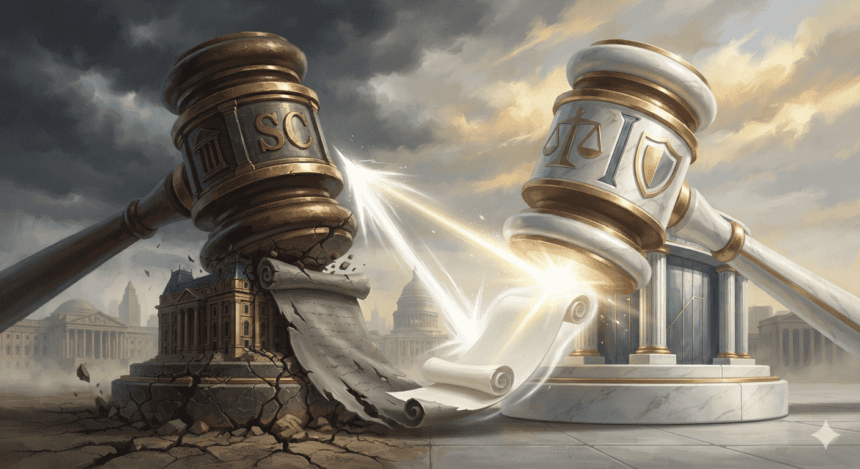
ISLAMABAD — The Federal Constitutional Court (FCC) delivered a stinging rebuke to the Supreme Court late Tuesday, overturning a landmark bench ruling that had previously settled a high-profile civil dispute. The decision marks the first time the newly empowered court has exercised its authority to strike down a final order from the apex judiciary, signaling a fundamental shift in the country’s legal hierarchy.
The case, which centered on the interpretation of property rights within the federal capital, had been considered closed after a three-judge Supreme Court panel issued a verdict just last month. By reopening the matter and effectively voiding that decision, the FCC has sparked an immediate debate over the limits of judicial review and the potential for a constitutional crisis.
“This is not merely a correction of a legal error,” said senior legal analyst Hamid Khan. “This is a direct confrontation between two pillars of the judiciary. It leaves litigants—and the lower courts—in a state of total uncertainty regarding which ruling holds final authority.”
The FCC’s ruling hinges on a narrow interpretation of Article 184(3), arguing that the original Supreme Court bench exceeded its jurisdiction by bypassing lower appellate forums. The Constitutional Court’s lead judge, Justice Aftab Malik, was blunt in his written opinion, noting that the apex court had effectively “created a shortcut that the constitution does not permit.”
For the parties involved, the ruling is a volatile reversal. The original petitioners, who had celebrated a decisive win in the Supreme Court, are now back to square one. Conversely, the respondents—who had exhausted their legal avenues—have been granted a reprieve that few expected.
The ruling has sent ripples through the legal community. Bar associations are already calling for an emergency meeting to discuss the implications of a “court above the court.” Critics argue that the FCC’s move risks politicizing the judicial process, while supporters claim the intervention was necessary to curb what they describe as “judicial overreach” by the Supreme Court.
Government officials have remained largely silent, choosing to frame the dispute as an “internal matter for the judiciary to resolve.” However, the tension between the two courts is palpable.
With the Supreme Court expected to hold a full-bench meeting on Thursday to discuss its response, the battle for judicial supremacy has only just begun. For now, the verdict stands, and the hierarchy of the nation’s courts remains in a state of unprecedented flux.