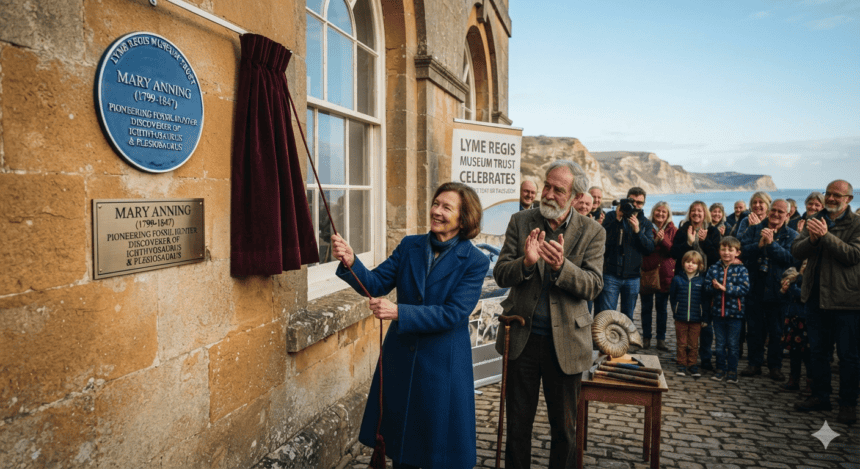
LYME REGIS, UK — Mary Anning, the 19th-century fossil hunter whose discoveries reshaped our understanding of prehistoric life, has been honored with a blue plaque at her former home in Lyme Regis. The tribute marks a quiet but significant correction to a history that long sidelined the working-class woman who unearthed some of the most important Jurassic marine fossils in Britain.
Anning began scouring the beaches of the Dorset coast as a child, selling “curiosities” to tourists to support her family after her father’s death. While she lacked a formal education, her ability to identify and extract complex skeletons—including the first correctly identified ichthyosaur and two nearly complete plesiosaur skeletons—earned her the respect of the era’s most prominent geologists.
Despite her expertise, the scientific establishment of the 1820s and 30s largely excluded her. The Geological Society of London did not admit women until 1919, nearly 72 years after Anning’s death. For decades, the men who purchased her finds published descriptions of the fossils, often omitting her name entirely or referring to her only as a “supplier.”
“Mary Anning was a titan of science, yet she was forced to operate on the periphery of the very field she helped build,” said local historian David Attenborough during the unveiling. “This plaque is more than a nod to history; it is a belated acknowledgment of a woman who saw the past more clearly than the peers who ignored her.”
The plaque now sits on the site of her former home and shop on Broad Street, where she spent much of her life. It serves as a physical anchor for her story, which has gained renewed international attention in recent years through biographies and film adaptations.
For the residents of Lyme Regis, the honor serves as a reminder of the fragility of historical recognition. Anning died in relative poverty at age 47, her contributions largely uncredited by the institutions that relied on her labor.
Today, those same institutions house her finds as cornerstones of their collections. The plaque ensures that visitors walking the same Dorset beaches where Anning once hunted now know exactly whose footsteps they are following.