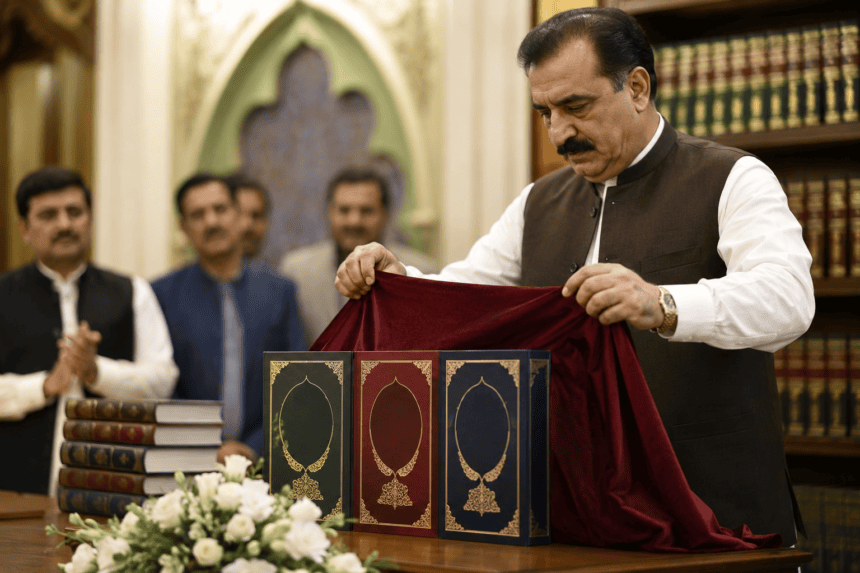
Federal Minister for National Heritage and Culture, Jamal Shah Aurangzeb Khichi, has officially launched the first three volumes of the revised Historical Urdu Dictionary. The project, spearheaded by the Taraqqi-e-Urdu Board, aims to preserve the linguistic evolution of Urdu while updating its vast vocabulary to meet modern academic standards.
The newly released volumes serve as more than just a reference tool. They document the etymological journey of words, tracking their shifting meanings and usage patterns across centuries of subcontinental history. For linguists, this marks a critical step toward formalizing the language’s complex heritage.
Speaking at the launch event, Minister Khichi emphasized that languages are living entities—constantly shifting with the cultures that speak them. “Our responsibility is to ensure these transformations are recorded accurately,” he told the audience. He credited the board’s researchers, who have spent years cross-referencing archival manuscripts to bring the project to this stage.
The initiative addresses a long-standing gap in Urdu studies, where the task of updating the national dictionary had languished for decades. By providing a standardized, historically grounded reference, the government hopes to provide students and scholars with a definitive resource that cuts through decades of linguistic ambiguity.
Work on the remaining volumes is already underway. The board has set a timeline for their completion, aiming to provide a comprehensive record that will eventually populate university libraries and research centers nationwide.
While the release of the first three volumes is a significant milestone, the true test lies in the consistency of the remaining work. The project remains a delicate balance between preserving classical roots and acknowledging the modern evolution of the Urdu language.