Pakistan’s immunization program is losing the race against time. Despite multi-billion dollar funding and international oversight, the country’s vaccination coverage remains stuck in a cycle of missed targets, leaving millions of children vulnerable to polio, measles, and diphtheria.
The breakdown isn’t just about supply lines or cold-chain logistics. It’s a crisis of trust and a failure of the frontline workforce. In districts across Khyber Pakhtunkhwa and Balochistan, health workers report a widening chasm between the state and the street.
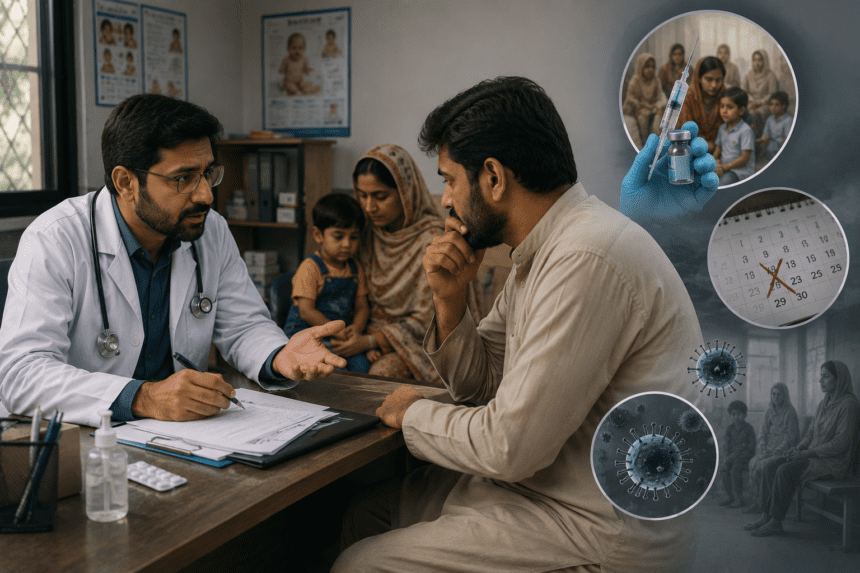
Parents aren’t just hesitant; they’re actively avoiding state-run clinics. When a mother refuses a polio drop, it’s rarely about the vaccine itself. It’s a protest against a system that provides free immunizations while failing to deliver clean water, functioning schools, or basic primary healthcare. “We show up at their door with a syringe, but we have nothing to offer for the hunger or the lack of sanitation,” says one provincial health supervisor, who requested anonymity for fear of professional reprisal.
“If you only visit a village when you want to vaccinate their children, the community sees you as an outsider with an agenda, not a healer.” The data reflects this disconnect. While national coverage numbers often look respectable on paper, the sub-district reality is grim. Urban slums—the “zero-dose” hotspots remain largely unreached.
These pockets of unvaccinated children act as incubators for viruses, ensuring that polio, which the world has largely eradicated, remains a persistent threat within Pakistan’s borders. The government’s response has been to double down on high-pressure, campaign-style drives. These “blitz” operations rely on thousands of volunteers hitting the streets for a few days, followed by a total withdrawal of services. It’s a temporary fix for a systemic structural failure. Public health experts argue this model is unsustainable, as it fails to build the long-term relationship between a patient and a primary care provider.
Funding isn’t the primary constraint, either. Pakistan’s polio program receives massive injections of capital from the Global Polio Eradication Initiative and various development partners. Yet, the persistent turnover of trained staff and the reliance on ad-hoc security arrangements for vaccinators suggest that the money is being poured into a bucket with a hole in the bottom.
Without a shift toward integrated healthcare where vaccination is just one part of a broader package of services the needle won’t move. Children in Karachi’s sprawling informal settlements or the remote valleys of the north don’t need another high-profile campaign.
They need a local clinic that stays open, keeps its supplies refrigerated, and is staffed by someone they actually trust. Until the state stops treating immunization as a top-down security mandate and starts treating it as a community health partnership, the gap will only grow. The next outbreak isn’t a matter of if, but when.