A new fossil study has revealed fresh insights into Cryolophosaurus, one of the earliest large predatory dinosaurs known from the Early Jurassic Period. The latest research is helping paleontologists better understand its anatomy, hunting abilities, growth, and evolutionary significance, offering a clearer picture of dinosaur life nearly 190 million years ago.
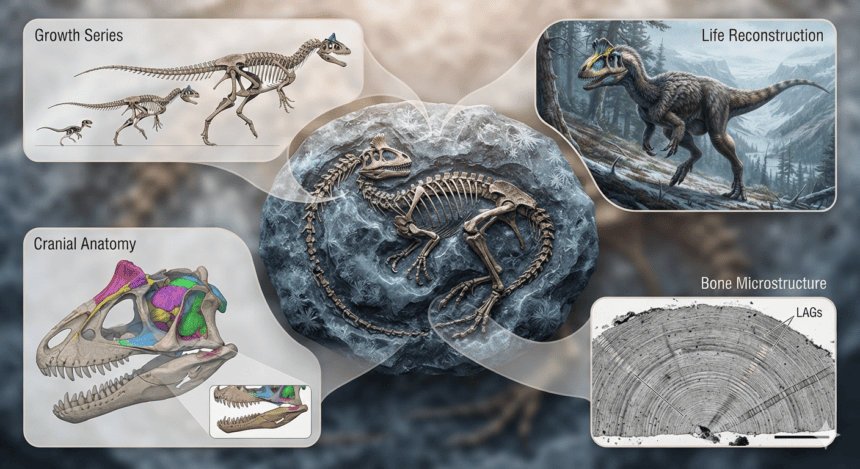
Researchers examined fossil remains using CT scanning, 3D digital reconstruction, and biomechanical analysis to investigate the dinosaur’s skull, jaws, limbs, and overall body structure. The findings suggest that Cryolophosaurus was a powerful and agile predator well adapted to its prehistoric environment.
Cryolophosaurus measured approximately 6 to 7 meters (20–23 feet) in length and is best known for the distinctive crest running across the top of its head. Scientists believe this unusual crest was most likely used for display, species recognition, or attracting mates rather than for combat.
The study indicates that Cryolophosaurus possessed strong hind limbs, sharp serrated teeth, and a long balancing tail that enabled it to chase and capture prey efficiently. Its lightweight but sturdy skeleton allowed for fast movement while maintaining strength during hunting.
Researchers also discovered new evidence about the dinosaur’s habitat. Fossils found in Antarctica suggest that, during the Early Jurassic, the continent had a much warmer climate with forests, rivers, and abundant vegetation, supporting a diverse range of prehistoric animals.
Scientists say Cryolophosaurus provides valuable clues about the early evolution of theropod dinosaurs and how large carnivorous species adapted to different environments before the breakup of the ancient supercontinent Gondwana.
Experts believe future fossil discoveries and advanced imaging technologies will continue to reveal new information about the biology, behavior, and evolution of this remarkable Antarctic predator.