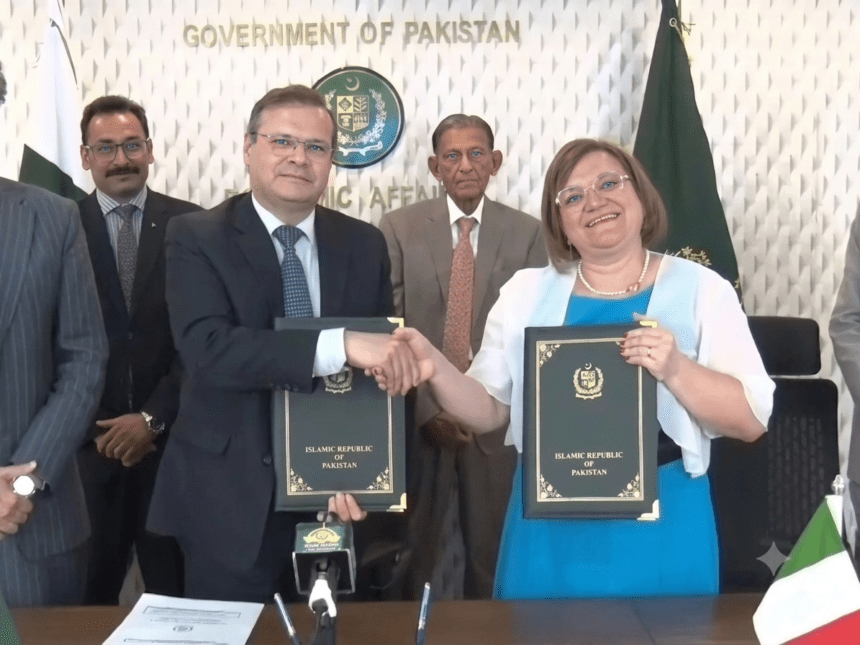
ISLAMABAD — Pakistan and Italy have officially signed a concessional loan agreement worth 20 million Euros (equivalent to PKR 6.3 billion) aimed at reforming the agricultural sector. The agreement was formally signed by Mohammad Humair Karim, Secretary of the Ministry of Economic Affairs, and Marilina Armellin, the Italian Ambassador to Pakistan. The primary objective of this joint initiative is to strengthen Pakistan’s technical and vocational education and training systems specifically within the agricultural industry. By introducing modern and market-driven training modules, the program will enhance the capabilities of local farmers and extension workers, promoting sustainable farming practices, maximizing crop yields, and upgrading the financial conditions of rural populations.
The 42-month comprehensive program will focus heavily on boosting high-value agricultural crops and fortifying agro-food value chains. Special training infrastructure will be constructed for individuals involved in horticulture production, processing, and marketing networks. The project will prioritize the optimization of key crops, including olives, pistachios, dates, mushrooms, cherries, grapes, peaches, and almonds, by combining advanced Italian agricultural expertise with Pakistan’s vast arable capacity. Over the course of the project, a total of 720 training courses will be conducted, directly benefiting 18,398 individuals, alongside the development of 11 standardized training curricula tailored for the agricultural domain.
According to the operational details provided by the Ministry of Economic Affairs, the project includes the establishment of 12 model orchards and nurseries, alongside the creation of 8 climate-resilient eco-friendly villages. Furthermore, 5 agro-food processing units and 2 National Centers of Excellence will be set up; one center will be located in Sargodha specializing in citrus and kinnow production, while the second will be established in Turbat to focus on date cultivation. The execution of this project will be overseen by the Pakistan Oilseed Department in close coordination with provincial agricultural departments. Official spokespersons concluded that the master plan will generate fresh employment opportunities across rural territories, boost farmer incomes, and significantly reduce post-harvest losses.