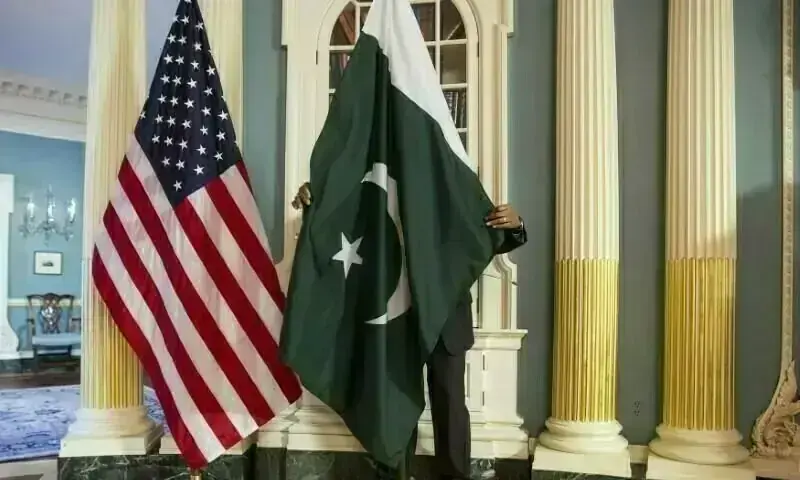
Pakistan has stepped up its lobbying campaign in Washington, opening a broader and more expensive effort aimed at reshaping ties with the United States at a moment when Islamabad is trying to sell itself as more than a security partner. The new push, according to U.S. foreign-agent filings, is not limited to diplomacy in the old sense. It reaches into defence, trade, tariffs, congressional outreach, public messaging and, increasingly, critical minerals.
At the center of that effort is an April 8, 2025 agreement between Pakistan and Orchid Advisors, filed under the U.S. Foreign Agents Registration Act. The contract says Orchid was hired to help “reset” the Pakistan-U.S. relationship on “political, diplomatic and defense related matters,” while building ties with the White House, State Department, Pentagon, Treasury, National Security Council and Congress. The filing also sets a monthly non-refundable retainer of $250,000, a figure that underlines how serious Islamabad appears to be about gaining access and influence in Washington.
The mandate is strikingly direct. Orchid’s filing says the longer-term objective is to reset Pakistan’s diplomatic, military and commercial relationship with the United States, with “particular emphasis on trade, tariffs and military matters.” It also lays out plans for advocacy with U.S. departments and congressional committees, along with efforts to shape narratives for American policymakers. That language makes clear Pakistan is not just seeking better optics. It is trying to position itself inside policy conversations that matter.
A parallel track appears in separate FARA records tied to Javelin Advisors. Those filings identify the Islamic Republic of Pakistan as the foreign principal, and a later supplemental statement says the firm helped communicate Pakistan’s views on major regional and global issues, including the Pakistan-India conflict and the development of critical minerals, to the U.S. executive branch, Congress and the public. That suggests Islamabad’s Washington strategy now blends geopolitical messaging with economic lobbying in a much more deliberate way than before.
Why minerals? Because that is where Pakistan sees fresh leverage. Islamabad has been pushing hard to market its mineral reserves to foreign investors, and in April 2025 it staged the Pakistan Minerals Investment Forum in Islamabad under the patronage of the Special Investment Facilitation Council and the Ministry of Energy. The event was designed to connect Pakistan’s mineral potential with overseas capital and technical partners.
That push has already produced visible U.S.-linked deals. In late 2025, Pakistan signed a $500 million memorandum of understanding with Missouri-based U.S. Strategic Metals. Reporting on the agreement said it covered development of critical mineral resources and plans for a poly-metallic refinery in Pakistan. Separate coverage also said two MoUs were signed between U.S. and Pakistani-linked entities to develop and process critical minerals, including rare earth elements.
The broader diplomatic context matters too. In a July 25, 2025 readout, the U.S. State Department said Secretary Marco Rubio and Pakistan’s Deputy Prime Minister and Foreign Minister Ishaq Dar discussed prospects for deeper bilateral counterterrorism cooperation, including against ISIS-K. By February 2026, Pakistan was also participating in the inaugural U.S. Critical Minerals Ministerial, with its energy minister attending talks focused on diversifying supply chains for minerals used in advanced technologies, clean energy and defence industries.
Taken together, the filings and the diplomacy point to a pretty clear strategy. Pakistan is trying to recast itself in Washington as a country that can offer three things at once: security cooperation, access to strategically important minerals, and a more active role in regional politics. That does not mean the reset is guaranteed. U.S.-Pakistan ties still carry years of mistrust, and Pakistan’s mineral story comes with hard questions around governance, security and local resistance, especially in Balochistan. But Islamabad seems to have decided that the way back into Washington is not through one door alone. It is knocking on all of them.