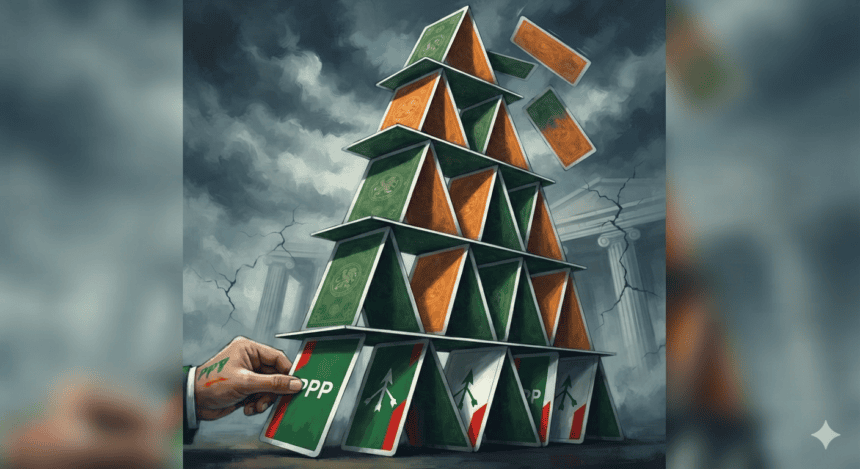
Prime Minister Shehbaz Sharif’s coalition government rests on a razor-thin margin in the National Assembly. While the PML-N leads the administration, the support of the Pakistan Peoples Party (PPP) remains the primary pillar keeping the government standing. Should Asif Ali Zardari’s party withdraw its backing, the current setup would face an immediate existential crisis.
The math is unforgiving. To maintain a simple majority in the 336-seat National Assembly, a government needs 169 votes. The PML-N holds 111 seats. Even with the support of the MQM-P, the PML-Q, and a few smaller allies, their numbers fall short of the magic 169 without the PPP’s 68 members.
If the PPP walks, the Sharif administration loses its legislative shield. The government would be unable to pass a budget, push through crucial finance bills, or survive a no-confidence motion. It would be reduced to a minority government—a position from which no administration in Pakistan’s parliamentary history has successfully governed for long.
“We are not in the cabinet, but we are supporting the system,” PPP Chairman Bilawal Bhutto-Zardari has repeatedly reminded his allies. That support is transactional. The PPP’s decision to stay or go doesn’t hinge on ideology; it hinges on political leverage. Whenever the PPP feels its provincial interests in Sindh are threatened or its role in federal decision-making is sidelined, the threat of withdrawal surfaces as a tactical maneuver.
The PML-N leadership understands this vulnerability. They have spent months balancing the demands of the military establishment—which largely brokered the coalition—against the shifting moods of the PPP leadership. But the friction is growing. Recent disagreements over electricity tariff hikes and the handling of the ongoing economic crisis have created visible cracks in the alliance.
Should the PPP pull the plug, the options for the PML-N are limited. They could attempt to form a new coalition by courting independent members or disgruntled lawmakers from the opposition benches, but such moves are fraught with legal and public-perception risks. Alternatively, they would be forced to call early elections—a scenario the PML-N has actively tried to avoid to allow more time for economic stabilization.
For now, the government remains intact, held together by the mutual fear of the alternative: a political vacuum that could empower their primary opposition, the PTI. However, the stability of this government is an illusion of convenience.
As long as the PPP holds the keys to the majority, Shehbaz Sharif is not just leading a country; he is managing a constant, high-stakes negotiation where one wrong move could trigger a snap election.