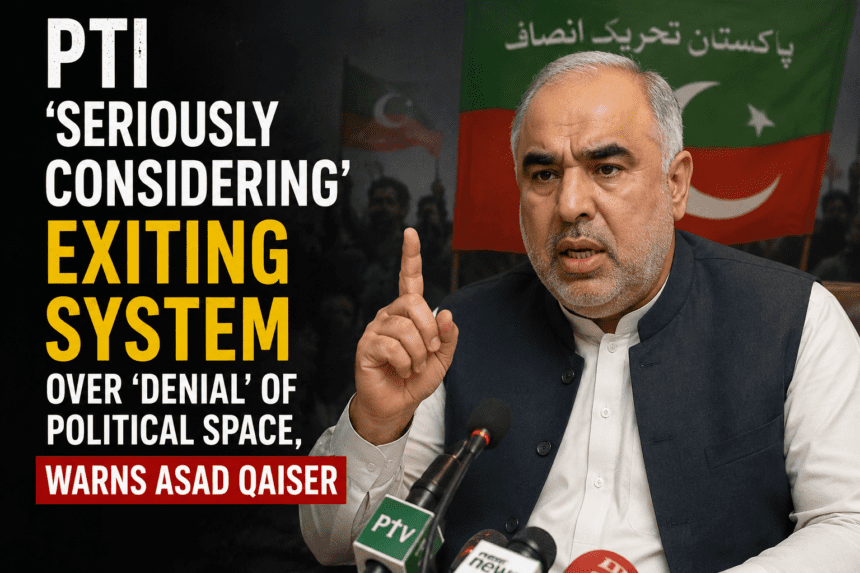
Pakistan Tehreek-e-Insaf senior leader Asad Qaiser has warned that the party is “seriously considering” leaving the political system if it continues to be denied political space, raising the temperature around the upcoming Gilgit-Baltistan elections.
Speaking on Geo News’ Naya Pakistan, the former National Assembly speaker said police stopped him for around 40 minutes while he was on his way to Islamabad airport for a flight to Skardu, where he was due to join PTI’s election campaign. He claimed he was released only after the flight had already departed.
Asad Qaiser linked the incident to what he called a wider pattern of pressure on PTI ahead of the GB polls, scheduled for June 7. “Who will accept such an election?” he asked, adding that it would be “better to make a selection” than hold elections under such conditions.
The PTI leader said the party still wanted a democratic way forward, including a new Charter of Democracy, fresh free and fair elections, and an Election Commission trusted by all political forces. But, frankly, his warning was blunt: if PTI’s mandate is not respected, “we can take any decision.”
Asked whether that could mean mass resignations from assemblies or even dissolving the PTI-led Khyber Pakhtunkhwa Assembly, Qaiser avoided giving a final answer. He said there were “various ways” to leave the system, but no final decision had been made.
The government rejected PTI’s charge. Minister of State for Interior Talal Chaudhry said authorities had no intention of stopping Qaiser, arguing that the episode was linked to security arrangements in the twin cities because of Australia’s cricket team presence in Rawalpindi.
The Express Tribune also reported that Qaiser accused Punjab police of barring him from entering Islamabad airport and keeping him in custody until his flight had left.
The warning comes as PTI is already crying foul over alleged restrictions in Gilgit-Baltistan, where the campaign has become another flashpoint in Pakistan’s long-running political standoff. For now, Qaiser’s statement looks less like a final announcement and more like a pressure signal — but it’s a serious one, and it puts the government on notice.